Pantanal Matogrossense National Park
| Pantanal Matogrossense National Park | |
|---|---|
| Parque Nacional do Pantanal Matogrossense | |
IUCN category II (national park) | |
  | |
| Nearest city | Corumbá, Mato Grosso do Sul |
| Coordinates | 17°40′19″S 57°26′42″W / 17.672°S 57.445°W |
| Area | 135,606 hectares (335,090 acres) |
| Designation | National park |
| Created | 24 September 1981 |
| Administrator | ICMBio |
Pantanal Matogrossense National Park (Portuguese: Parque Nacional do Pantanal Matogrossense) is a national park in the state of Mato Grosso in Brazil.
Place
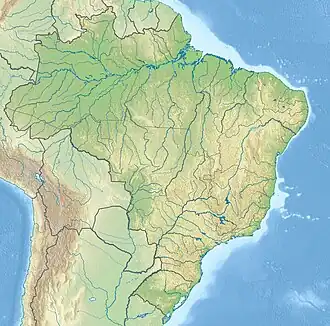
Pantanal Matogrossense National Park is 135,606 hectares (335,090 acres) in size. It is in the Pantanal place. People made the place into a park by decree nº 86.392 on 24 September 1981. The Chico Mendes Institute for Biodiversity Conservation (ICMBio) takes care of the park.[1] The park covers parts of the towns of Corumbá in Mato Grosso do Sul and Cáceres and Poconé in Mato Grosso.[2] This park is next to Guirá State Park. The Cuiabá River goes through Pantanal Matogrossense National Park.[3] The park is in the Pantanal Biosphere Reserve, which also has the Chapada dos Guimarães, Emas, and Serra da Bodoquena national parks and the Serra de Santa Bárbara, Nascentes do Rio Taquari, and Pantanal de Rio Negro state parks in it.[4]
Conservation
The IUCN calls this park an IUCN protected area category II (national park). The park is to protect natural ecosystems and beautiful land and let people do scientific research, environmental education, visit nature, and have fun outside.[2] The park was listed as a "Wetland of International Importance" under the Ramsar Convention in 1993.[5]
There are many protected species in the park: jaguar (Panthera onca), ocelot (Leopardus pardalis), marsh deer (Blastocerus dichotomus), giant anteater (Myrmecophaga tridactyla), giant armadillo (Priodontes maximus), giant otter (Pteronura brasiliensis), chestnut-bellied guan (Penelope ochrogaster), black-and-tawny seedeater (Sporophila nigrorufa), and the mussel Lamproscapha ensiformis.[1]
References
- 1 2 Parna do Pantanal Mato-grossense – Chico Mendes.
- 1 2 Unidade de Conservação ... MMA.
- ↑ PES do Guirá – ISA, Informações gerais (mapa).
- ↑ Carrijo & Torrecilha 2009, p. 2.
- ↑ Ramsar List.
Sources
- Carrijo, Martha GilkaGutiérrez; Torrecilha, Sylvia (June 2009), Plano de Manejo do Parque Estadual das Nascentes do Taquari (PDF), Campo Grande – Mato Grosso do Sul: IMASUL: Instituto do Meio Ambiente de Mato Grosso do Sul, archived from the original (PDF) on 2016-12-20, retrieved 2016-12-13
{{citation}}: CS1 maint: publisher location (link) - Parna do Pantanal Mato-grossense (in Portuguese), Chico Mendes Institute for Biodiversity Conservation, archived from the original on 2016-03-03, retrieved 2016-05-02
- PES do Guirá (in Portuguese), ISA: Instituto Socioambiental, retrieved 2016-12-08
{{citation}}: CS1 maint: publisher location (link) - Ramsar List, Ramsar.org, retrieved 14 April 2013
- Unidade de Conservação: Parque Nacional do Pantanal Matogrossense (in Portuguese), MMA: Ministério do Meio Ambiente, retrieved 2016-05-02
{{citation}}: CS1 maint: publisher location (link)
