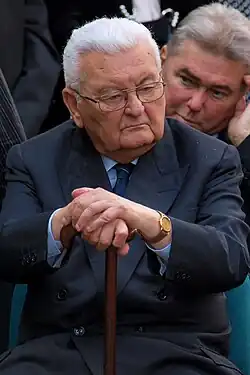
Péter Boross
Péter Boross | |
|---|---|
 | |
| Prime Minister of Hungary 2nd Prime Minister of the Third Republic of Hungary | |
| In office 12 December 1993 – 15 July 1994 | |
| President | Árpád Göncz |
| Preceded by | József Antall |
| Succeeded by | Gyula Horn |
| Personal details | |
| Born | 27 August 1928 Nagybajom, Hungary |
| Political party | MDF (1992–2010) |
| Spouse(s) |
Ilona Papp
(m. 1952; died 2010) |
| Children | 3 |
Péter Boross (born 27 August 1928) is a Hungarian politician who served as the Prime Minister of Hungary from 1993 to 1994. He is also known for his contributions to the country's transition to democracy in the wake of communism's collapse.
Early life
Péter Boross was born on August 27, 1928, in Nagybajom, Hungary. His father, György Boross (1896–1993), fought in World War I and later worked as a forest engineer. His mother, Lujza Horváth (1905–1993), came from a smallholder farming family, a distant branch of the extinct noble Perneszy family in Somogy County. She was fond of Hungarian literature and theatre, especially Sándor Márai's writings. Boross had a younger brother, László (born 1932), who worked as a teacher. They grew up in Nagybajom and Újvárfalva, where they finished elementary school. In 1938, Boross began studying at a military secondary school in Kőszeg, and later continued at a cadet school in Pécs. During the final phase of World War II, his school moved to Sopron, and then to Butzbach. He escaped from there and returned to Hungary through Vienna. He completed his final school exams in 1947 in Kaposvár, a year later than usual because of the war.
He graduated as a jurist from the Faculty of Law, Eötvös Loránd University in 1951. After finishing legal education, Boross intended to become a lawyer, however the reputation and salary of the profession reduced during the Stalinist era, thus he began to work at the Metropolitan Council of Budapest. He was a lecturer at the Finance Department under the leadership of Ferenc Nezvál, who later served as Minister of Justice.
During the Hungarian Revolution of 1956, he was elected as a member of the Revolutionary Committee of Budapest and of the Revolutionary Council of the Intellectuals. As a result, he was fired from the Metropolitan Council in January 1957, following the crushing of the revolution. After that Boross worked as an unskilled worker in toy manufacturing. Finally, he was arrested for his role during the revolution in July 1957. After interrogations, he was transferred to an internment camp in Kistarcsa. Following his release soon after, Boross and his family were put under police surveillance in the forthcoming years until 1959.
Entrepreneurial career
Boross started his career in the catering industry as an inspector of stores in October 1957. However he was fired because of his past in 1956, and after that worked as a bartender in the Szikla Restaurant at Budapest Zoo and Botanical Garden. Some months later he moved to the Széchenyi thermal bath's buffet. In September 1958 he became assistant manager in a restaurant at Kőbánya (District X, Budapest). He became manager in 1961, and his financial conditions stabilized by that time. Then he also became group leader on trade in goods at the local Catering Company in 1962. In this capacity, Boross took part in the organization of tertiary training of professionals in the Hungarian hospitality sector and tourism.
Through the intercession of József Venesz, the most well-known chef in the Kádár regime, Boross was promoted to Deputy Director of the South-Pest Catering Company in 1965. During that time the company had two hundred catering units. The New Economic Mechanism, a major economic reform launched in 1968, was a "comprehensive reform of the economic system", creating market relationships among firms. On 21 December 1971, Boross became Director of the South-Pest Catering Company. He retired from this workplace and became a pensioner on 1 February 1989.
Political career
Péter Boross's political career began in 1990, when he was appointed as Hungary's Minister of the Interior in József Antall's government. He went on to serve as the Prime Minister of Hungary from 1993 to 1994, succeeding Antall after his death. As Prime Minister, Boross focused on strengthening Hungary's economy and implementing further democratic reforms. He introduced a series of measures aimed at improving the country's fiscal position and attracting foreign investment. He also worked to improve relations with neighboring countries, including Romania and Slovakia. Boross's tenure as Prime Minister was marked by significant political and economic challenges. His government was criticized for its handling of the economy, which was still recovering from the effects of communism. There were also tensions between Boross's Hungarian Democratic Forum (MDF) party and its coalition partners, which ultimately led to the collapse of his government in 1994. After his tenure as Prime Minister, Boross continued to be an active member of Hungary's political scene, serving as a member of parliament and as a member of the Hungarian European Parliament delegation. He also served as the president of the Hungarian National Association of Radio Amateurs and was active in several charitable organizations. Boross retired from active politics in 2010 but remains a respected and influential figure in Hungarian political circles.
Later life
Since retiring from active politics in 2010, Péter Boross has continued to be involved in public life through various activities.
On 6 June 2010, following the 2010 parliamentary election, when Fidesz won a two-thirds majority, he became a member of the board advising Prime Minister Viktor Orbán on the conceptual foundations of the new Hungarian constitution.[1] In this capacity, Boross stated that he can envision a new constitutional government in the form of a kingdom. Furthermore, he said that it is necessary to place broader authority and more powerful political authority into the hands of the Prime Minister by way of the new constitution.
He has remained an active commentator on political and social issues, frequently contributing opinion pieces to newspapers and appearing on television and radio programs. In addition, he has served on the board of several organizations, including the Hungarian Atlantic Council and the Robert Schuman Foundation. Boross has also remained active in promoting Hungarian culture and history, serving as the honorary president of the Hungarian National Museum and participating in various cultural events. Despite his advancing age, he remains an influential figure in Hungarian public life and continues to be highly respected for his contributions to the country's political and economic development.
Today, Boross is regarded as an important figure in Hungary's transition to democracy and its emergence as a free-market economy. His contributions to the dismantling of Hungary's secret police force and the establishment of a multi-party system have had a lasting impact on the country's political landscape.
Personal life
Boross' father died in a household accident on 11 August 1993, aged 97. His mother, Lujza Horváth died five weeks later. On 13 September 1952, Boross married his former classmate, Ilona Papp, who worked as a judge. Their church wedding took place in the Szilágyi Dezső Square Reformed Church on 13 March 1953. They were married from 1952 until her death in 2010.[2] They had three children together, though his eldest son Péter died only aged nine months old in February 1958.
Boross is known for his interest in history, particularly the history of Hungary and the Austro-Hungarian Empire. He is also an avid amateur radio operator and has been involved in the Hungarian National Association of Radio Amateurs for many years. Boross has received numerous awards and honors throughout his career, including the Order of Merit of the Republic of Hungary and the Order of Saint Stephen, the highest honor in Hungary.
References
- ↑ "Megtartotta első ülését az új alkotmányon dolgozó bizottság". Origo.hu. 2010-06-09. Retrieved 2015-11-06.
- ↑ "Gyászhír". Hungarian Democratic Forum. Archived from the original on 18 August 2010. Retrieved 7 October 2017.
{{cite web}}: CS1 maint: bot: original URL status unknown (link)
Other websites
 Media related to Péter Boross at Wikimedia Commons