Oval
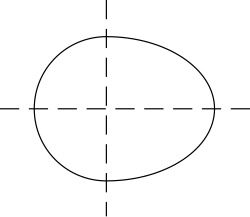
An oval is a shape. It is round but a bit longer in one direction. An oval can look like an egg or an ellipse.[1][2][3][4]
Oval shape and etymology
An oval is a flat (2D) shape that looks like an egg. According to etymology, the word “oval” comes from the Latin for “egg” (ovum).
Mathematical definition of an oval
Eggs in nature have many different shapes, so a mathematical formula should be able to describe many types of egg shapes.[5]
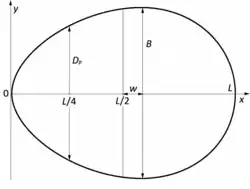
To describe an oval, we can use its four main measurements:[6]
- Length (L) – the total length of the oval.
- Maximum breadth (B) – the widest part of the oval.
- Shift of the maximum breadth (w) – how far the widest point is from the center along the long axis (usually x-axis).
- Breadth at one-quarter length (Dp) – the width at one-quarter of the length from the pointed end.
These four values help define the shape of the oval.
A mathematical formula[6] should be able to draw the oval using these parameters. To make calculations easier, the length is often set to 1 (L = 1). Then the other values are written as ratios:
- Shape index: B/L (which becomes B when L = 1).
- Asymmetry index: w/L (which becomes w when L = 1).
- Conicity index: Dp/B.
By changing these index values, we can create many different oval shapes. For example:[6]
- A circle has no asymmetry and equal length and width.
- An ellipse is longer than it is wide but still symmetrical.
- A classic egg shape is slightly asymmetrical.
- A pear-shaped (pyriform) egg has stronger asymmetry.
- A biconical shape (that is based on two oppositely oriented cones) has two pointed ends.
Some values can also produce shapes similar to a superellipse.[6] This is a particular family of closed curve like an ellipse. Specifically, it is a curve that lies between the ellipse and the rectangle as described elsewhere, for example, in the Martin Gardner Mathematical Games columns. Because the index values can vary a lot, this formula can describe many natural and geometrical shapes.
Notes
- ↑ 1911 Encyclopædia Britannica/Oval.
- ↑ "Oval Shape: Meaning, Properties, Construction, Examples". Cuemath: Geometry. Wilmington, DE, USA: CueLearn Inc. Archived from the original on 2026-03-27. Retrieved 2026-04-28.
- ↑ "Oval: Meaning of oval in English". Cambridge Dictionary. Cambridge, UK: Cambridge University Press & Assessment. 2026. Archived from the original on 2026-03-07. Retrieved 2026-04-28.
- ↑ Huerta, S. (October 2007). "Oval domes: History, geometry and mechanics" (PDF). Nexus Network Journal. 9 (2): 211–248. doi:10.1007/s00004-007-0040-3. eISSN 1522-4600. ISSN 1590-5896. Archived (PDF) from the original on 2012-04-13. Retrieved 2026-04-28.
- ↑ Dixon, R. (1991). Mathographics. Dover Recreational Math Series; General Science Series. New York, NY, USA: Dover Publications. ISBN 0486266397.
- 1 2 3 4 Narushin, V.G.; Orszulik, S.T.; Romanov, M.N.; Griffin, D.K. (April 2026). "What is an oval, officially and overall? Old and new mathematical descriptions". Computation. 14 (5) 101. Basel, Switzerland: MDPI. doi:10.3390/computation14050101. ISSN 2079-3197.