Otoya Yamaguchi
- In this Japanese name, the family name is Yamaguchi.
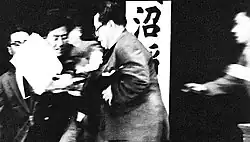
Otoya Yamaguchi (山口二矢, Yamaguchi Otoya; February 22, 1943-November 2, 1960) was a Japanese political activist and assassin. He killed Inejirō Asanuma, the head of the Japanese Socialist Party (JCP).[1] On October 12, 1960, the killing was broadcast live by NHK television.[2]
Assassin
Yamaguchi was an assassin because he killed a politically active man. His reasons for the murder were political.
Yamaguchi was a member of a radical group. In 1960, he killed Inejiro Asanuma, a Socialist, when he was at a public meeting. Soon after, Yamaguchi killed himself in a juvenile center. He wrote on the wall of the room in which he hung himself. His last words were written using a paste made from tooth powder and water.[3] He wrote "Seven lives for my country ..." which was a reference to the last words of 14th century samurai Kusunoki Masashige.
Political irony
There is a political irony in this killing. Inejiro Asanuma shared some views with right-wing nationalists like Yamaguchi. Asanuma supported the religious group Seichō no Ie, just like Yamaguchi. He deeply respected the Emperor. He kept a kamidana (small Shinto altar) in his home and did daily rituals. He was against the Japanese Communist Party. He was a democratic socialist from the right wing of the Socialist Party, not a communist.
Even the Emperor showed respect for Asanuma. Emperor Hirohito condemned the assassination. On 17 October 1960, he sent a special religious offering (saishiryō) to Asanuma’s family. This was very rare for a socialist politician. The next day, the Emperor spoke to the Diet and called for peace and unity in Japan.[4][5][6][7]
Legacy
Yasushi Nagao captured the assassination in a dramatic photograph.[8] The image won the 1960 World Press Photo award.[9]
Nobel Prize-winning writer Kenzaburō Ōe based his book Seventeen on Yamaguchi.[10]
Related pages
References
- ↑ Socialist Leader is Slain in Tokyo; Asanuma, Who Led Agitation Against U.S. Treaty, Is Stabbed at a Rally," New York Times. October 12, 1960; retrieved 2012-3-15.
- ↑ TokyoReporter.com, "Assassin of Inejiro Asanuma remembered by right-wing groups on 50-year anniversary," October 14, 2010; retrieved 2012-3-15.
- ↑ "Leftist's Killer Suicide in Japan; Young Rightist Who Stabbed Asanuma Hangs Himself in Detention Center," New York Times. November 3, 1960; "Assassin's Apologies," Archived 2012-03-20 at the Wayback Machine Time. November 14, 1960; retrieved 2012-3-15.
- ↑ 浅沼稲次郎. "浅沼稲次郎の三つの代表的演説". www.aozora.gr.jp (in Japanese). Retrieved 2026-05-12.
- ↑ "【櫻LIVE】 君の一歩が朝(あした)を変える!". 言論テレビ (in Japanese). Retrieved 2026-05-12.
- ↑ "『ああ!ヌマさんありせば』". 新労社 おりおりの記 (in Japanese). Retrieved 2026-05-12.
- ↑ Times, Robert Trumbullspecial To the New York (1960-10-19). "HIROHITO APPEALS FOR PUBLIC ORDER; Emperor, in Speech to Diet, Urges Japanese to Shun Violence as Voting Nears". The New York Times. ISSN 0362-4331. Retrieved 2026-05-12.
- ↑ Howell, Brian (5 April 2020). "Tokyo Stabbing". Retrieved 29 December 2022.
- ↑ 1960 World Press Photo by Yasushi Nagao; retrieved 2012-3-15.
- ↑ Remmick, David. "Reading Japan," New Yorker. February 6, 1995; retrieved 2012-3-15.
Other websites