Orbiting Carbon Observatory
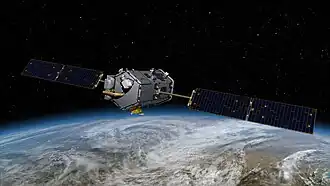 Artist rendition of the OCO satellite as it would look in orbit | |
| Mission type | Climatology |
|---|---|
| Operator | NASA |
| Mission duration | Launch failure Planned: 2 years |
| Spacecraft properties | |
| Bus | LEOStar-2 |
| Manufacturer | Orbital Sciences[1] |
| Launch mass | 530 kg (1,170 lb)[1] |
| Payload mass | 150 kg (330 lb)[1] |
| Dimensions | Stowed: 2.3 × 1.4 m (7.5 × 4.6 ft)[1] |
| Power | 786 W[1] |
| Start of mission | |
| Launch date | 24 February 2009, 09:55:31 UTC[2] |
| Rocket | Taurus-XL 3110 |
| Launch site | Vandenberg LC-576E |
| Contractor | Orbital |
| Orbital parameters | |
| Reference system | Geocentric |
| Regime | Sun-synchronous |

| |
The Orbiting Carbon Observatory (OCO) was a NASA satellite mission that was supposed to provide world-wide observations of atmospheric carbon dioxide from space. (CO2). It was lost in a launch failure on February 24, 2009, when the box of the Taurus rocket which was carrying it failed to come off during launch.[3] The added weight of the box it was in prevented the satellite from reaching its intended speed and height.[4] After that it fell back into the atmosphere and crashed[5] into the Indian Ocean near Antarctica.[6]
References
- 1 2 3 4 5 Parkinson, Claire L.; Ward, Alan; King, Michael D., eds. (2006). "Orbiting Carbon Observatory" (PDF). Earth Science Reference Handbook. NASA. pp. 199–203. Retrieved 14 May 2015.
- ↑ "Overview of the Orbiting Carbon Observatory (OCO) Mishap Investigation Results For Public Release" (PDF). NASA. Retrieved 5 November 2018.
{{cite journal}}: Cite journal requires|journal=(help) - ↑ "OC'O Blog". Archived from the original on 2009-02-26. Retrieved 2009-02-25.
- ↑ https://www.newscientist.com/article/dn16657-co2tracking-satellite-crashes-after-liftoff.html CO2 satellite crashes after lift-off
- ↑ "National Geographic".
- ↑ https://www.washingtonpost.com/wp-dyn/content/article/2009/02/24/AR2009022401803.html?hpid=topnews