Omar al-Mukhtar
Omar al-Mukhtar | |
|---|---|
عُمَر الْمُخْتَار | |
 | |
| Leader of Senussi Tribal Military | |
| In office 24 April 1923 – 16 September 1931[1] | |
| Personal details | |
| Born | 20 August 1858 Benghazi, Eyalet of Tripolitania, Ottoman Empire |
| Died | 16 September 1931 (aged 73) Suluq, Italian Cyrenaica |
| Known for | Leading native resistance to Italian colonization of Libya |
| Nickname(s) | Shaykh ash-Shuhadā (Arabic: شَيخ الشُّهَدَاء) |
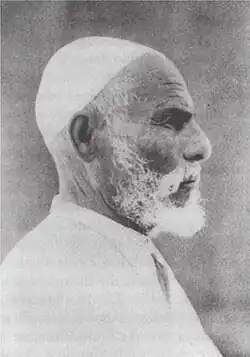
Omar al-Mukhtar (Arabic: عمر المختار, 20 August 1858 – 16 September 1931), called The Lion of the Desert, was a Libyan revolutionary and Muslim religious teacher. He led the native resistance in Eastern Libya against the Italian colonization of Libya from 1911 until his death in 1931.[1] He is considered the national hero of Libya and a symbol of freedom in the Arab and Islamic worlds.[2]
Early life
Omar Al-Mukhtar was born in 1858 near Tobruk in eastern Libya, which was then part of the Ottoman Empire. He lost his father at a young age and grew up in poverty.[3] He studied for eight years at the Senussi University in Jaghbub, a holy city for the Senussi movement, where he became an Imam and an expert on the Quran.[3]
Because of his leadership skills, the Senussi movement sent him to Chad in 1899 to help defend the region against the invading French military forces.[2] In 1902, he returned to northern Libya to manage local religious and social affairs as a Sheikh.[4]
The Italian invasion
In October 1911, during the Italo-Turkish War, the Italian navy attacked the Libyan coast and demanded the surrender of Tripoli and Benghazi.[5] The Ottoman forces and local Libyans refused to surrender and withdrew into the countryside to fight back. This was the start of a long colonial war.[5]
Guerrilla warfare
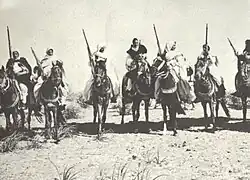
Al-Mukhtar was a teacher by trade, but he was also highly skilled in desert warfare. He used his deep knowledge of local geography to fight the Italian army, which was not used to the harsh desert environment.[6] He led small, fast groups of fighters to ambush Italian troops, attack their outposts, and cut their supply lines.[6]
In 1930, Italian General Rodolfo Graziani took command. To defeat Al-Mukhtar, Graziani put more than 100,000 local Libyan people into concentration camps on the coast and built a wire fence along the border with Egypt.[1] This stopped Al-Mukhtar’s fighters from getting food, weapons, or information from the people, which slowly weakened the resistance.[3]
Capture and execution
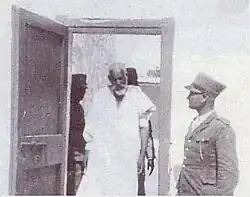
On 11 September 1931, Al-Mukhtar was wounded in battle and captured by colonial troops near Slonta.[7] On 16 September 1931, he was hanged to death by the Italian military court at the Suluq concentration camp before his followers.[7] He was 73 years old, and he refused to surrender until the very end.[1]
Legacy
- His image appears on the Libyan 10-dinar banknote.[8]
- His life story and fight against the Italians were shown in the famous 1981 movie Lion of the Desert, starring Anthony Quinn.[8]
- Many major streets are named after him across Arab countries, including Egypt, Jordan, Palestine, and Saudi Arabia.[2]
Gallery
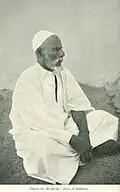 Omar Mukhtar sitting
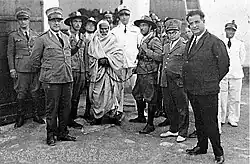 Al-Mukhtar surrounded by Italian officers after his capture
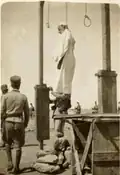 The execution of Omar al-Mukhtar in 1931
References
- 1 2 3 4 Federica Saini Fasanotti, "Counterinsurgency through the Sources of the Italian Army Libya 1922-1931" (Historical Office of the Italian Army, 2010) p. 296
- 1 2 3 as Salab, Ali Muhammad (2011). Omar Al Mokhtar Lion of the Desert (The Biography of Shaikh Omar Al Mukhtar). London: Al-Firdous. p. 1.
- 1 2 3 Rodolfo Graziani, "Cirenaica Pacificata" pg.269 (Benamer translation; originally published by A. Mondadori, Milan, 1932)
- ↑ Muhammad Fuad Shukri, "Al-Sanusiyya: A Faith & A State". Youssef El-Megreisi (editor) pg.271
- 1 2 Vandervort, Bruce (1998). Wars Of Imperial Conquest In Africa, 1830-1914. London: Routledge. p. 261.
- 1 2 "Libya profile - Timeline", BBC News Asia, 1 November 2011
- 1 2 Quirico, Domenico (2002). Lo squadrone bianco. Storia delle truppe coloniali italiane. Milan: Edizioni Mondadori Le Scie. p. 313.
- 1 2 "History through Libyan eyes", BBC News, 28 March 2011