Occupation of Constantinople
| Occupation of Istanbul | ||||||||||
|---|---|---|---|---|---|---|---|---|---|---|
| Part of the partition of the Ottoman Empire and the Turkish War of Independence | ||||||||||
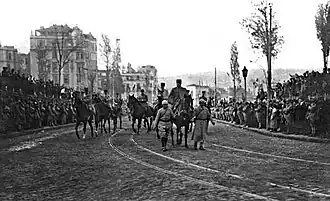 Louis Franchet d'Espèrey marching in Beyoğlu, 8 February 1919 | ||||||||||
| ||||||||||
| Belligerents | ||||||||||
 Italy  Greece |
 Ottoman Empire |
Turkish National Movement | ||||||||
| Commanders and leaders | ||||||||||
 Somerset Arthur Gough-Calthorpe George Milne  Louis Franchet d'Esperey Carlo Sforza[2] Efthimios Kanellopoulos (1918–1921) Charalambos Simopoulos (1921–1923) |
Ali Sait Pasha¹ |
Selâhattin Âdil Pasha2 | ||||||||
| Strength | ||||||||||
|
Land forces on 13 November 1918:[3] 2,616 British, 540 French, 470 Italian (Total: 3,626 soldiers) Land forces by 5 November 1919:[4]  : 27,419 soldiers (27 artillery batteries, 160 machine guns) : 19,069 soldiers (30 cannons, 91 machine guns): 3,992 soldiers: 795 soldiers (160 machine guns) Total: ~51,300 soldiers (411 machine guns, 57 artillery pieces) Naval forces: 13 November 1918: 50[5]–61[6] warships 15 November 1918: 167 warships+auxiliary ships[7][8] | ||||||||||
|
1: Commander of the XXV Corps and the Constantinople's Guard (6 October 1919 – 16 March 1920[9]) 2: Commander of the Istanbul Command (10 December 1922 – 29 September 1923[10]) | ||||||||||

Occupation of Constantinople was a military conflict between the allied forces of France , Italy, Greece and Britain against the Ottoman tinople . Constantinople was occupied by the allied forces and merged into Greece while the State of Turkey was officially recognised.
References
- ↑ "Constantinople occupied by British and Indian troops". British Pathé. 30–31 October 1918. Retrieved 25 April 2012.
- ↑ "Missioni all'estero:1918–1923. In Turchia: da Costantinopoli all'Anatolia" (in Italian). Arma dei Carabinieri. Archived from the original on 6 May 2014. Retrieved 8 November 2012.
- ↑ Hülya Toker Mütareke döneminde İstanbul Rumları, Genelkurmay Basımevi, 2006, ISBN 9754093555, p. 29. (in Turkish)
- ↑ Zekeriya Türkmen, (2002), İstanbul'un işgali ve İşgal Dönemindeki Uygulamalar (13 Kasım 1918 – 16 Mart 1920), Atatürk Araştırma Merkezi Dergisi, XVIII (53): pp. 338–39. (in Turkish)
- ↑ Paul G. Halpern: The Mediterranean Fleet, 1919–1929, Ashgate Publishing, Ltd., 2011, ISBN 1409427560, p. 3.
- ↑ Metin Ataç: İstiklal Harbi'nde Bahriyemiz, Genelkurmay Başkanlığı, 2003, ISBN 9754092397, p. 20. (in Turkish)
- ↑ Mustafa Budak: İdealden gerçeğe: Misâk-ı Millî'den Lozan'a dış politika, Küre Yayınları, 2002, p. 21. (in Turkish)
- ↑ Ertan Eğribel, Ufuk Özcan: Türk sosyologları ve eserleri, Kitabevi, 2010, ISBN 6054208624, p. 352. (in Turkish)
- ↑ T.C. Genelkurmay Harp Tarihi Başkanlığı Yayınları, Türk İstiklâl Harbine Katılan Tümen ve Daha Üst Kademelerdeki Komutanların Biyografileri, Genelkurmay Basımevi, 1972, p. 51.
- ↑ T.C. Genelkurmay Harp Tarihi Başkanlığı Yayınları, Türk İstiklâl Harbine Katılan Tümen ve Daha Üst Kademelerdeki Komutanların Biyografileri, Genelkurmay Başkanlığı Basımevi, Ankara, 1972, p. 118. (in Turkish)