Nigihayahi
| Nigihayahi | |
|---|---|
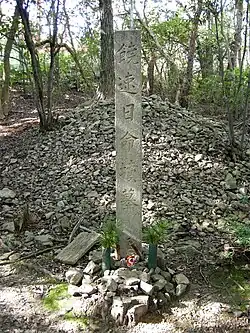 Tomb of Nigihayahi | |
| Personal information | |
| Parents |
|
Nigihayahi is a Japanese god.[1] He is mentioned in the Kojiki, Kujiki, and Nihon Shoki[2]
He was involved with the Tenson Korin (descent of gods from Heaven).[3] The Mononobe clan[4] and the Hozumi clan said he was their ancestor.[5]
The Kujiki says he is the same god as Amenohoakari but this is questionable.[5] The book is considered a forgery.[6]
Some books say he is the older brother of Ninigi,[7] or the son of Ame-no-oshihomimi.[1]
Jimmu's Eastern Expedition
During Jimmu's Eastern Expedition Jimmu and his brothers reached Osaka, they encountered a chieftain named Nagasunehiko ("the long-legged man"). They fought and Itsuse was killed in the ensuing battle[8][9][10][11][12][13][14][15]
Nagasunehiko claimed to follow Nigihayahi.[1][15] Jimmu lost, but he came back and won,[16] Nigihayahi killed Nagasunehiko and submitted to Jimmu.[1][15]
After this he recognized Jimmu as the rightful Emperor of Japan and Jimmu became Emperor.[17]
In popular culture
He is present in Ghost of Tsushima.[18]
References
- 1 2 3 4 5 "Nigihayahi | 國學院大學デジタルミュージアム". 2023-03-21. Archived from the original on 2023-03-21. Retrieved 2023-12-05.
- 1 2 Como, Michael (2009-09-02). Weaving and Binding: Immigrant Gods and Female Immortals in Ancient Japan. University of Hawaii Press. ISBN 978-0-8248-2957-5.
- ↑ Satomi, Kishio (2013-07-04). Discovery of Japanese Idealism. Routledge. ISBN 978-1-136-39365-5.
- ↑ Cali, Joseph; Dougill, John (2012-11-30). Shinto Shrines: A Guide to the Sacred Sites of Japan's Ancient Religion. University of Hawaii Press. ISBN 978-0-8248-3775-4.
- 1 2 Hoga, Toshio (2007). Shoki Mononobe-uji no Keifu (1) Kokigi no Heya (初期物部氏の系譜 (1) 古樹紀之房間). Japan.
{{cite book}}: CS1 maint: location missing publisher (link) - ↑ Motosawa, Masafumi (2007-03-28). "Encyclopedia of Shinto - Home : Shinto Classics and Literature : Sendaikujihonki". Encyclopedia of Shinto. Archived from the original on 2012-02-07. Retrieved 2025-06-19.
- ↑ Barnes, Gina (2007-03-12). State Formation in Japan: Emergence of a 4th-Century Ruling Elite. Routledge. ISBN 978-1-134-38469-3.
- ↑ Bunko (Japan), Tōyō (1975). Memoirs of the Research Department.
- ↑ "Kamuyamatoiwarebiko | 國學院大學デジタルミュージアム". 2023-03-21. Archived from the original on 2023-03-21. Retrieved 2023-11-23.
- ↑ Monbushō, Japan; Brinkley, Frank (1893). History of the Empire of Japan. Dai Nippon Tosho Kabushiki Kwaisha, by order of the Department of Education. Printed at the Japan Mail Office, Yokohama.
- ↑ Roberts, Jeremy (2009). Japanese Mythology A to Z. Infobase Publishing. ISBN 978-1-4381-2802-3.
- ↑ Anonymous (2023-09-29). The Great Events: Vol. 1. BoD – Books on Demand. ISBN 978-3-368-19823-7.
- ↑ Weiss, David (2022-01-13). The God Susanoo and Korea in Japan's Cultural Memory: Ancient Myths and Modern Empire. Bloomsbury Publishing. ISBN 978-1-350-27119-7.
- ↑ James, David H. (2010-11-01). The Rise and Fall of the Japanese Empire. Routledge. ISBN 978-1-136-92547-4.
- 1 2 3 Various (2022-09-16). Japan: From the Japanese Government History. DigiCat.
- ↑ 朝廷軍の侵略に抵抗 (in Japanese). Iwate Nippo. September 24, 2004. Archived from the original on March 3, 2016. Retrieved March 1, 2011.
- ↑ "メンテナンス中". Archived from the original on 2025-04-26. Retrieved 2024-03-25.
- ↑ "Charm Of Nigihayahi-No-Mikoto - Location & Effects | Ghost Of Tsushima". GameWith. 2022-08-21. Retrieved 2023-12-05.