National Assembly (Hungary)
National Assembly Országgyűlés | |
|---|---|
| 2026–2030 term | |
 | |
| Type | |
| Type | |
| History | |
| Founded | 1848 |
| Leadership | |
Deputy Speakers | |
Leader of largest political group | |
Leader of 2nd largest political group | |
| Structure | |
| Seats | 199 |
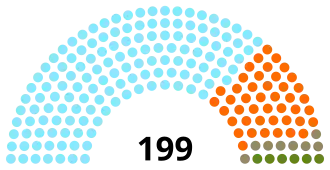 | |
Political groups | Government (141)
Opposition (58) |
| Elections | |
Partially parallel, partially compensatory voting:
| |
Last election | 12 April 2026 |
| Meeting place | |
 | |
| Hungarian Parliament Building Lajos Kossuth Square 1 Budapest, H-1055 Hungary | |
| Website | |
| parlament.hu/national-assembly | |
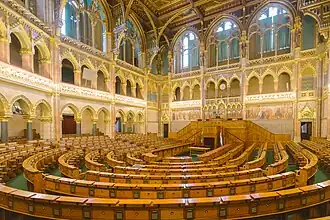
The National Assembly (Hungarian: Országgyűlés; "Country Assembly") is the parliament of Hungary. It is made up of 199 members elected to 4-year terms. The election of members is based on a system involving both area and list election. Parties must win at least 5% of the popular vote in order to enter the list of members of the assembly (but area winners enter regardless). The assembly has met in the Hungarian Parliament Building in Budapest since 1902.[1]
The National Assembly makes laws and adopt decisions. It elects its own officers, the President of Hungary, the Prime Minister, the members and President of the Constitutional Court, the President of the Supreme Court, the President of the National Judicial Office, the Commissioner for Fundamental Rights and their deputies, the Governor of the Hungarian National Bank, the Prosecutor General, and the President of the State Audit Office.
History
The Hungarian Diet was a law-making body in the Kingdom of Hungary from the 1290s, and later in the Lands of the Crown of Saint Stephen.
In 1608, Hungary created a two-part law-making body called the Royal Hungarian Diet, which had an upper and a lower house. The upper house included rich nobles and high-ranking religious leaders like archbishops and bishops. The lower house had representatives from regular nobles, religious people, and townspeople: elected officials from noble areas, delegates from free royal cities, and lower Church representatives.
The estates parliament was replaced in 1848 by a parliament based on popular representation. Under a single-round, relative-majority electoral system, Hungarian men who had reached the age of 20 and met the property qualification were eligible to vote.
The assembly has been a unicameral body since 1945.
Under communist rule, the National Assembly was called the highest power in the country. The 1949 Constitution gave it big powers to make laws and watch over things. But like other communist law-making bodies, it mostly just approved decisions already made by the Socialist Workers' Party and its leaders. The Assembly met only twice a year.
The Assembly includes 25 standing committees to debate and report on introduced bills and to overlook the activities of the ministers.
References
- ↑ Katerina Zacharia, Hellenisms: culture, identity, and ethnicity from antiquity to modernity, Ashgate Publishing, Ltd., 2008, p. 237 ISBN 978-0-7546-6525-0