Munakata clan
| Munakata clan | |
|---|---|
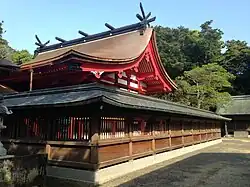 Munakata Taisha Honden | |
| Home province | Chikuzen Province |
| Parent house | Kuni no miyatsuko |
| Founder | disputed original ancestor
possibly Ame no Hohi historically first known Kiyoshi Munakata |
The Munakata clan (宗像氏) is a Japanese clan that looks after Munakata Taisha.[1] The clan was known for being skilled at sailing.[2] They are said to have the same origin as the Izumo clan, but they serve the daughters of Susanoo instead of Susanoo himself.[3][3][4]: 151–153
Members of the clan are buried in the Shinbaru-Nuyama Kofun Cluster.[5]
The clan had strong ties with the Imperial family. They sometimes married into the imperial family and kept trade with mainland Asia even after Japan stopped official missions to China. They also controlled sea trade and rights.[6]
Today, only priests live on Okinoshima, a sacred island with a large stone altar. From 1954 to 1972, archaeologists studied the island and found signs of old religious ceremonies and objects from the 4th to 9th centuries. These finds helped people understand early Shinto worship.[6]
Over 100,000 objects have been found on Okinoshima. Some came from China, Korea, and Iran. Many are now National Treasures or Important Cultural Properties. People are not allowed to talk about what happens on Okinoshima or take anything from it.[6]
If the clan began as Kuni no miyatsuko and later became priests at Munakata Taisha, they share a similar past with the Aso clan of Aso Shrine, the Owari clan of Atsuta Shrine, the Izumo clan of Izumo-taisha,[1] the Amabe clan of Kono Shrine,[7] and the Yamato clan of Ōyamato Shrine.
Related pages
- Yamato clan
- Izumo clan
- Aso clan
- Owari clan
- Tsumori clan
- Amabe clan
- Tanba clan
- Urabe clan
- Sarume clan
- Kii no Kuni no Miyatsuko
- Yagi clan
References
- 1 2 Matsunaga, Naomichi. "Kuni no miyatsuko". Kokugakuin University Encyclopedia of Shinto. Archived from the original on 2023-10-25. Retrieved 2023-10-25.
- ↑ "The Sacred Island of Okinoshima and Associated Sites in the Munakata Region". The Sacred Island of Okinoshima and Associated Sites in the Munakata Region. Retrieved 2023-12-01.
- 1 2 "Tagorihime". Encyclopedia of Shinto. Retrieved 2024-03-24.
- ↑ https://www.munakata-archives.asia/Dat/bunken/0000000073_02.pdf
- ↑ "The Sacred Island of Okinoshima and Associated Sites in the Munakata Region". The Sacred Island of Okinoshima and Associated Sites in the Munakata Region. Retrieved 2023-12-01.
- 1 2 3 Nogami, Takahiro. "Munakata Shinkō". Kokugakuin University Encyclopedia of Shinto. Retrieved 2023-10-25.
{{cite web}}: CS1 maint: url-status (link) - ↑ "海部氏系図" [Amebe shikeizu] (in Japanese). Agency for Cultural Affairs. Retrieved August 20, 2020.