Muhammad Sadiq (photographer)
Muhammad Sadiq | |
|---|---|
 | |
| Born | 1822 or 1832 Cairo, Egypt Eyalet, Ottoman Empire |
| Died | 1902 (aged 79–80 or 69–70) |
| Occupation(s) | military surveyor, photographer, author |
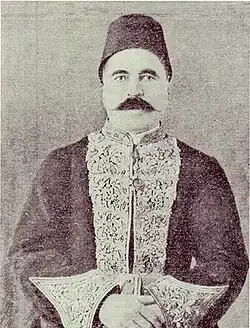
Muhammad Sadiq Bey[notes 1] (1822 or 1832 – 1902[notes 2]) was an army engineer and surveyor in the Ottoman Empire. He was the treasurer of the Hajj pilgrims who went from Cairo to Mecca. He took photographs of, and wrote about, the Islamic holy places at Mecca and Medina. His photographs of those places are the first ever taken in what is now Saudi Arabia.
Life and career
Born in Cairo, Sadiq went to Cairo's military college and to the École Polytechnique in Paris.[1] He became a colonel in the Egyptian army[2] and went back to the military college to teach map drawing.[1]
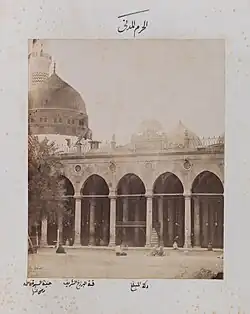
In 1861, the army sent him to Arabia to write a survey of the area near Medina. He took a small team and some equipment. He was not ordered to take photographs, but brought his own camera.[2] His writings from this trip are the oldest detailed records of the places and their weather.[1] His photographs of Medina were the first ever taken there. In 1880 he went with the Hajj pilgrims from Egypt to Mecca.[3] Again he brought his camera. He was the first person to photograph Mecca, the Great Mosque, the Kaaba, and camps at Mina and Arafat.[2][3]
In the 1870s he got the title Bey. Two decades later, he had a higher rank, Pasha. By the end of his career he became a liwa, like a Major-General. He was the governor of the Egyptian city of Arish, but only for a short time. After getting sunstroke there, he went back to Cairo. He had a wife for 34 years; she died while with him in Medina.[2] Sadiq died in Cairo in 1902.[2][3]
Photographs
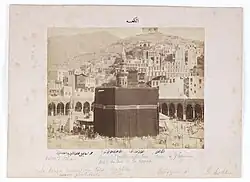
Sadiq used a wet-plate collodion: a kind of camera invented in the 1850s. This needed a portable darkroom. He made prints which he signed or, later, stamped.[2]
In Mecca and Medina there are the holiest places of Islam. One of the Five Pillars of Islam is the Hajj, in which pilgrims visit Mecca and other nearby places.[5] On his trips from 1861 to 1881, Sadiq took photographs on the pilgrims' path and at Medina. He photographed The Prophet's Mosque and other places in Medina on 11 February 1861. He wrote in his diary that day that no one had taken photographs there before.[2]
By getting up on walls and the roofs of mosques, he took panoramas of the cities.[3] He also photographed people connected to the holy places.[2]
In 1876, he showed his photographs of Medina in Philadelphia. He showed twelve photographs at the 1881 Third International Conference of Geographers in Venice, where he won a gold medal. He published those photographs in a book with text in French.[2]
His photographs are now in the Khalili Collection of Hajj and the Arts of Pilgrimage,[6] the Victoria and Albert Museum,[7] the Reiss Engelhorn Museum,[1] and the Harvard Fine Arts Library.[8] Claude Sui, a curator, has praised the quality of Sadiq's photography and his ability with the camera.[1] Sadiq's work shows a map-maker's understanding of space[3] and a Muslim's link to the places and people.[1]
Publications
The report of his 1861 visit to Medina was in the Egyptian Military Gazette in 1877. It then became a book, Summary of the Exploration of the Wajh-Madinah Hijaz Route and its Military Cadastral Map.[2]
His other books include:[9]
- Collection de Vues Photographiques de La Mecque et de Médine, 1881. This was a set of twelve photographs of places of the Hajj.
- Mash'al al-mahmal ("The Torch of the Mahmal"), 1881.
- Kawkab al-hajj fi sayr al-mahmal bahran wa sayrihi barran ("The Star of the Hajj along the Travels of the Mahmal by Sea and Land"), 1886.
- Dalil al-hajj li'l-warid nin Makkah wa al-Madinah ("The Guide to the Hajj for Those Arriving in Mecca and Medina from every Direction"), 1896.
All his books have photographs and advice for pilgrims based on his visits to the area.[9] His books in French were a summary of his work. They left out facts that were in his Arabic writings. This is why, for a long time, his work was not known outside the Arabic world.[1]
Gallery
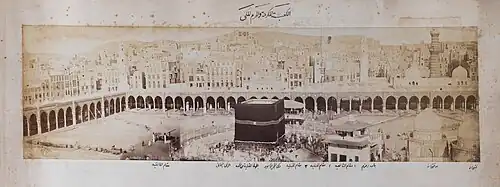 Panorama of the Kaaba in Mecca
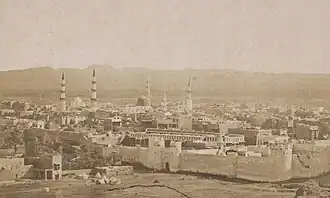 A view of Medina with the Prophet's Mosque and its Green Dome
Notes
- ↑ His Arabic name is also written as Sadiq, Sadic, Sadik, or Sadek.[1]
- ↑ Some sources give his birth date as 1832 and say he died at age 70;[2][3] others give his birth as 1822. The Library of Congress, National Library of Israel, and German National Library give both birth years.[4]
References
- 1 2 3 4 5 6 7 8 Sui, Claude W. (2017). "Early Photography of the Holy Sites of Islam in the Arabian Peninsula". In Ritter, Markus; Scheiwiller, Staci G. (eds.). The Indigenous Lens? : Early Photography in the Near and Middle East. Berlin/Boston: De Gruyter. ISBN 978-3-11-059087-6. OCLC 1020031954.
- 1 2 3 4 5 6 7 8 9 10 11 de St. Jorre, John (1999). "Pioneer Photographer of the Holy Cities". Saudi Aramco World (January/February 1999). Retrieved 2 August 2021.
- 1 2 3 4 5 6 Sheehi, Stephen (12 April 2016). The Arab Imago: A Social History of Portrait Photography, 1860–1910. Princeton University Press. pp. xvii–xx. ISBN 978-0-691-15132-8.
- ↑ "90061188". Virtual International Authority File. Retrieved 27 August 2021.
- ↑ Long, Matthew (2011). Islamic Beliefs, Practices, and Cultures. Marshall Cavendish Corporation. pp. 86–87. ISBN 978-0-7614-7926-0.
- ↑ Khan, Qaisra (2021). "Photographic views of Hajj, by Muhammad Sadiq Bey". Discover Islamic Art. Retrieved 3 August 2021.
- ↑ "Search Result – Muhammad Sadiq Bey". Victoria and Albert Museum. Archived from the original on 3 August 2021. Retrieved 3 August 2021.
- ↑ Burton, Robert. "Cataloging Is Preservation: An Emerging Consideration in Photograph Conservation Programs" (PDF). Topics in Photographic Preservation. 16. American Institute for Conservation of Historic & Artistic Works: 158–166.
- 1 2 "al-haram al-madani ('The Sanctuary at Medina')". Khalili Collections. Retrieved 2 August 2021.
External links
 Media related to Muhammad Sadiq (photographer) at Wikimedia Commons