Mount Magnet
Mount Magnet is a town in the Mid West region of Western Australia. It is one of the oldest gold mining towns in the region and has been a place for gold mining for a very long time. The town is named after a nearby hill, which explorer Robert Austin named in 1854 because its rocks affected his compass. The Aboriginal name for this hill is Warramboo, which means "campfire camping place.".[1]
| Mount Magnet Western Australia | |||||||||
|---|---|---|---|---|---|---|---|---|---|
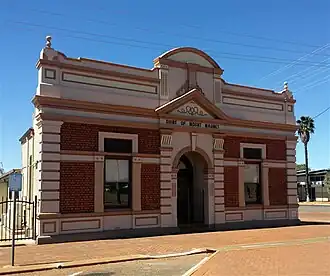 Mt Magnet Shire Office b.1898 | |||||||||
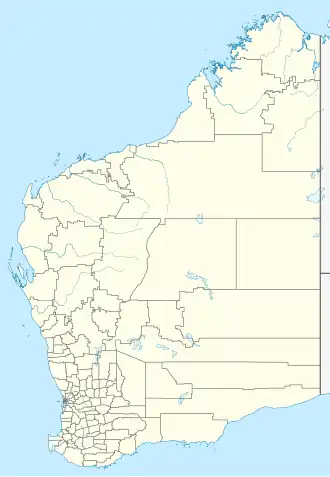  Mount Magnet | |||||||||
| Coordinates | 28°3′36″S 117°50′46″E / 28.06000°S 117.84611°E | ||||||||
| Population | 576 (as of 2021) | ||||||||
| Elevation | 426 m (1,398 ft) | ||||||||
| Location | |||||||||
| Region | Mid West | ||||||||
| Website | Mount Magnet | ||||||||
| |||||||||
Geography
Mount Magnet is about 573 km north of Perth, the capital of Western Australia. It is in a dry area known as the Murchison goldfields. The land around the town is mostly flat with some hills, including Warramboo Hill. The climate is hot and dry.
History
Gold was found in the Mount Magnet area in 1891. This started a gold rush, and many people came to the area looking for gold. A townsite was planned and officially created in 1895.
The railway reached Mount Magnet in 1897, which helped the town grow. The town became a very important center for gold mining and for the sheep farms (pastoral stations) in the area.
Over time, other towns were created nearby, like Boogardie and Lennonville. However, Mount Magnet is the town that has survived the longest. Mining has continued in the area for many years, and there is still gold mining happening today.
Demographics
Mount Magnet has a small population. The area has a long history for Aboriginal people, and their culture is still important in the region.
- ↑ "Mount Warramboo" State Heritage Office. 28/05/97. Web. 01/04/16. http://inherit.stateheritage.wa.gov.au/Public/Inventory/Details/0abf1a0d-dcb6-4200-b4de-321e33dc7576