Mount Logan
| Mount Logan | |
|---|---|
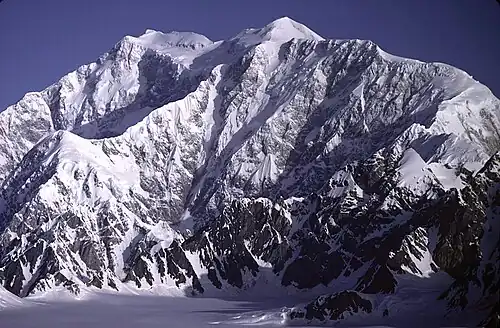 Mount Logan from the southeast | |
| Highest point | |
| Elevation | 5,959 m (19,551 ft) |
| Prominence | 5,250 m (17,220 ft)[1] |
| Parent peak | Denali |
| Isolation | 622 km (386 mi)  |
| Listing | Seven Second Summits Country high point Ultra |
| Coordinates | 60°34′02″N 140°24′10″W / 60.56722°N 140.40278°W |
| Geography | |
| Location | Yukon, Canada |
| Parent range | Saint Elias Mountains |
| Topo map | NTS 115B |
| Climbing | |
| First ascent | 1925 by A.H. MacCarthy et al. |
| Easiest route | Glacier/snow/ice climb |
Mount Logan is the highest mountain in Canada. It is the second-highest mountain in North America, after Denali (Mount McKinley). The mountain was named after Sir William Edmond Logan. He was a Canadian geologist and the founder of the Geological Survey of Canada (GSC). Mount Logan is in Kluane National Park and Reserve[2] in southwestern Yukon. People think that Logan has the largest base circumference of any non-volcanic mountain on Earth. The massif has eleven peaks over 5,000 metres (16,400 ft).[3][4]
Temperatures are extremely low on and near Mount Logan. On the 5,000 m (16,400 ft) high plateau, air temperature stays around −45 °C (−49 °F) in the winter. It reaches near freezing in summer. Little snow melt leads to a large ice cap, reaching almost 300 m (984 ft) in certain spots.[4]
References
- ↑ "Mount Logan". Bivouac.com. Retrieved January 31, 2019.
- ↑ "Kluane National Park and Reserve of Canada". Parks Canada. Archived from the original on March 5, 2016. Retrieved August 1, 2010.
- ↑ "Mount Logan". Geological Survey of Canada. Archived from the original on September 21, 2012. Retrieved April 12, 2007.
- 1 2 "Mount Logan: Canadian Titan". Virtual Museum of Canada. Archived from the original on February 4, 2012. Retrieved September 18, 2008.