Mixed number
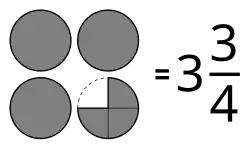
A mixed number (also called a mixed fraction) is a number which contains a whole number and a fraction added together. For instance 1 ½, in words "one and a half", is the same as 1 + ½, or "one plus one half." This rational number can also be written as the fraction or with decimal notation as 1.5.

Usage
Mixed numbers are the main way of writing ratios larger than 1 in primary education. They are also used for some measurements, like fractions of an inch in American units. Mixed numbers are useful to show people where a number fits between whole numbers.
Mixed numbers are almost never used for rational numbers in formal mathematics. Arithmetic with mixed numbers involves many more steps compared to "improper" fraction notation:

Mixed numbers can't easily represent irrational numbers like . This is an "improper fraction" in that the numerator is greater than the denominator, but the mixed number cannot be simplified.


Similar ideas
An Egyptian fraction is similar to a mixed number, but instead of having one fraction, it has a sum of fractions that all have the numerator 1.
Rational functions where the degree of the numerator is greater than the degree of the denominator can be treated like improper fractions. The mixed number equivalent is a polynomial and a simpler rational function where the degree of the numerator is less than that of the denominator. This is similar to a mixed number, with the polynomial acting as the "whole" part and the lower degree rational function being the "fraction" part.
Examples
| Mixed number in plain text | Mixed number in math notation | Mixed number in words | Equivalent improper fraction | Equivalent decimal | Picture | Picture description |
|---|---|---|---|---|---|---|
| 1 1/2 | One and a half | 3/2 | 1.5 | 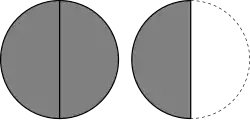 |
The picture shows 1 ½ circles shaded in grey. | |
| 3 3/4 | Three and three quarters | 15/4 | 3.75 | |
The picture shows circles shaded in grey. |

