Mihrimah Sultan (daughter of Suleiman I)
| Mihrimah Sultan | |||||
|---|---|---|---|---|---|
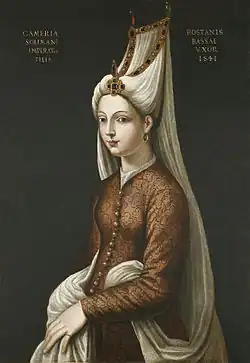 Portrait by Cristofano dell'Altissimo titled Cameria Solimani, 1541 | |||||
| Born | September/November 1522 Old Palace, Constantinople, Ottoman Empire | ||||
| Died | 25 January 1578 (aged 55) Old Palace, Constantinople, Ottoman Empire | ||||
| Burial | Süleymaniye Mosque, Istanbul | ||||
| Spouse |
Rüstem Pasha
(m. 1539; died 1561) | ||||
| Issue | Ayşe Hümaşah Sultan Sultanzade Osman Bey | ||||
| |||||
| Dynasty | Ottoman | ||||
| Father | Suleiman the Magnificent | ||||
| Mother | Hürrem Sultan | ||||
| Religion | Sunni Islam | ||||
Mihrimah Sultan (Ottoman Turkish: مهرماه سلطان; tr; September/November 1522[1] – 25 January 1578) was an Ottoman princess, the daughter of Ottoman Sultan Suleiman the Magnificent and his wife Roxelana (Hürrem Sultan). She lived during the golden age of the Ottoman Empire and became one of the most influential royal women of her time.
Mihrimah received a strong palace education and grew up in a political environment shaped by her powerful parents. In 1539, she married Rüstem Pasha, who later became Grand Vizier. Through this marriage, she gained influence in government affairs and remained close to her father, especially after her mother’s death.
She also sponsored important architectural projects, including two mosques in Istanbul designed by Mimar Sinan. According to historian Mustafa Selaniki, she was the most powerful imperial princess in Ottoman history and a leading figure of the Sultanate of Women.
Name
The name Mihrimah or Mihrümah[2][3] comes from the Persian language. In Persian, it means "Sun and Moon",[4] or sometimes "Light of the Moon".[5] The name is formed from two Persian words: mihr, which means "sun", and mah, which means "moon".[6] Because of this beautiful meaning, the name suggests brightness, beauty, and balance between two important symbols of light. In Ottoman culture, names often had deep meanings and were carefully chosen. As the daughter of the sultan, Mihrimah’s name reflected both elegance and importance. The sun and the moon were strong symbols in poetry and royal imagery. They represented power, beauty, and divine light. Giving such a name to a princess showed her high status and the hopes connected to her future.
In Western Europe, Mihrimah Sultan was known by a different version of her name. Western writers called her Sultana Cameria.[7] This name comes from Qamariyyah, which is the Arabic version of her name and also relates to the word for "moon." In many languages, the moon is linked with beauty and grace, especially when describing royal women. One of her portraits, painted by Cristofano dell'Altissimo, was titled Cameria Solimani.[8] This title again shows how Europeans adapted her name into forms that were easier for them to pronounce and understand. Mihrimah was also called Hanım Sultan, which means "Madam Princess".[9] This title was a respectful way to address a high-ranking royal woman in the Ottoman Empire. It combined honor and formality, showing her noble position.
Overall, Mihrimah Sultan’s name carried strong cultural, poetic, and royal meanings. It connected her identity to light, beauty, and power, fitting for one of the most important princesses of the Ottoman Empire.
Early life
Mihrimah Sultan was born in Istanbul in 1522,[10][11][12] during the reign of her father, Suleiman the Magnificent, one of the most powerful rulers of the Ottoman Empire. She was the only daughter of Suleiman and his wife, Roxelana, also known as Hürrem Sultan. Roxelana came from an Eastern Orthodox Christian family and was the daughter of a priest. She entered the imperial harem as a concubine but later was freed around 1533 or 1534 and became Suleiman’s legal wife.[13] This gave Mihrimah a special position in the palace, as her mother was not only the sultan’s favorite but also a legally recognized wife.
Mihrimah grew up in a privileged and highly political environment. Her family was very powerful, and she spent her childhood inside the imperial palace. She had five full brothers: Şehzade Mehmed, Şehzade Selim (who would later become Selim II), Şehzade Abdullah who died at age three, Şehzade Bayezid, and Şehzade Cihangir.[11][14] Being the daughter of the sultan and the sister of future sultans meant that Mihrimah was closely involved in the life of the royal family and had an important status in the palace hierarchy. From an early age, Mihrimah received a thorough education. Like other children of the imperial family, she was trained in reading, writing, and literature. She was taught Islamic teachings, the Qur’an, and the traditions of the Ottoman court. She also learned languages and gained knowledge about history and poetry. Her education helped her become well-spoken and intelligent. She developed skills in communication and diplomacy, which later helped her influence political matters in the empire. She was considered sophisticated, eloquent, and well-read.[13]
Mihrimah’s childhood was shaped not only by her education but also by the strong presence of her mother, Hürrem Sultan. Hürrem was deeply involved in politics and had the ability to influence Suleiman’s decisions. Growing up under the guidance of such a mother allowed Mihrimah to understand palace politics, court etiquette, and how power worked in the Ottoman Empire. She observed the relationships between the sultan, his advisors, and members of the harem, which gave her early insight into leadership and governance. Her upbringing emphasized discipline and responsibility. She was expected to behave with dignity, respect elders, and follow palace rules strictly. At the same time, she learned to navigate social relationships and manage her household, which were essential skills for a princess. Mihrimah’s personality combined intelligence, charm, and a careful understanding of human behavior. These traits would later make her one of the most influential women of the Ottoman Empire.
Mihrimah Sultan’s early life set the stage for her later achievements. Her noble birth, strong education, and exposure to palace politics prepared her for an important role in state affairs. She not only inherited the status of a princess but also the ability to act wisely in political and social matters. Her family connections, combined with her knowledge and skills, allowed her to participate in decision-making and support her father and later her brothers in matters of governance. Mihrimah Sultan’s early life was a combination of privilege, learning, and preparation for future influence. She grew up in the heart of the Ottoman Empire, surrounded by wealth, culture, and politics. Her childhood experiences shaped her into a thoughtful, educated, and capable princess who would leave a lasting mark on Ottoman history.
Marriage
In 1539, Mihrimah Sultan, the daughter of Sultan Suleiman the Magnificent and Hürrem Sultan, was married to Rüstem Pasha.[13] Rüstem Pasha was likely from Croatia and had been taken as part of the devshirme system, which was a practice where Christian boys were recruited by the Ottoman Empire to serve in various positions. He grew up within the Ottoman system and worked his way up through the ranks to become governor of Diyarbakır.[15][16] Before the marriage, rumors spread that Rüstem Pasha had leprosy, but the doctor who examined him found these claims were false. The only issue noted was a louse in his clothing, although he changed his garments daily.[17]
The wedding took place on 26 November 1539,[18][19][20][21][22] and was celebrated in the Old Palace. On the same day, her younger brothers, Şehzade Bayezid and Şehzade Cihangir, had their circumcision ceremonies.[23][21][24] The celebrations lasted for fifteen days, with festivities, feasts, music, and many guests from the palace and government. The Ottomans held such grand celebrations to show the importance of royal weddings and family events. Five years after the marriage, in 1544, Sultan Suleiman appointed Rüstem Pasha as grand vizier, the highest administrative post in the empire. He held this position until his death in 1561. However, there was a short two-year period when he was removed after the execution of Şehzade Mustafa in 1553 to calm public unrest.[25][26][27][25] Mihrimah’s marriage to Rüstem strengthened her position in the palace and gave her influence through her husband’s high office, although he was often kept separate from the sultan’s personal life.
Shortly after her wedding, Mihrimah developed a disease similar to rheumatoid arthritis. She suffered from pain and swelling in her joints, which she managed for the rest of her life.[25] Despite her illness, she traveled in 1544 to Bursa with her mother and husband, accompanied by a large military escort.[25] She and her mother attempted to bring Rüstem closer to Sultan Suleiman, but he was kept at a distance and not fully trusted in intimate royal affairs.[25] Mihrimah and Rüstem had children who played important roles in the royal family. Their daughter, Ayşe Hümaşah Sultan, was born in 1541.[28] They also had a son, Sultanzade Osman Bey, born in 1546, who later died in 1576.[30] In 1554, Mihrimah suffered a miscarriage that almost cost her life. Some sources suggest the couple lived in Pera, across the Golden Horn, but it is more likely they settled in Mihrimah’s palace in Üsküdar.[32]
Mihrimah continued her life as an important figure in the Ottoman court. In March 1558, Shaykh Qutb al-Din al-Nahrawali, a respected religious leader from Mecca, visited Istanbul. He met Mihrimah and presented her with gifts, showing her high status in society. He met her again in June before leaving for Cairo.[34][35][36] After Rüstem Pasha died in 1561,[38] Mihrimah considered remarrying and offered to marry Semiz Ali Pasha, who had succeeded her husband as grand vizier. When he declined her offer, she chose not to marry again.[40] Instead, she returned to live in the royal palace and focused on managing her household, engaging in charitable works, and maintaining her influence in the court.[42]
During her marriage, Mihrimah also focused on charitable and social projects. She sponsored the construction of buildings, religious schools, and fountains. These works helped the poor, provided public services, and strengthened her image as a generous and responsible princess. Her contributions to architecture and society demonstrated her active role in public life and her ability to influence both politics and society, even while managing her illness. Throughout her marriage, Mihrimah balanced her responsibilities as a princess, a wife, and a mother. She remained closely involved in the politics of the court through her husband and maintained her father’s favor. Her intelligence, education, and experience from childhood allowed her to navigate complex palace affairs. Even after her husband’s death, her influence remained strong due to her family connections and her own reputation for wisdom and leadership.
Mihrimah Sultan’s marriage to Rüstem Pasha was a central part of her life. It brought her closer to the power structures of the Ottoman Empire, allowed her to participate in politics indirectly, and provided a platform for her charitable and social activities. Her life as a wife, mother, and princess showed her resilience, intelligence, and dedication to her family and the empire. She remained an important figure in Ottoman history until her later years.
Political affairs
Mihrimah Sultan was not only a princess but also a highly influential political figure in the Ottoman Empire. She played an important role in palace politics, diplomacy, and social affairs during the reign of her father, Suleiman the Magnificent, and later during the rule of her brothers and nephews. Her political activity shows that Ottoman princesses, especially during the period known as the Sultanate of Women, could wield significant power both inside and outside the palace.
Mihrimah’s involvement in politics began indirectly during the rivalry between her half-brother Şehzade Mustafa and her full brothers, especially Şehzade Bayezid. Although there is no direct evidence that she had a hand in Mustafa’s downfall, both Ottoman and foreign sources suggest that many believed she worked alongside her mother, Hürrem Sultan, and her husband, Rüstem Pasha, to remove him from power. Mustafa was considered a threat to the future of her full brothers because, according to Ottoman fratricidal custom, a new sultan would often execute his brothers to prevent civil war. Mustafa’s execution in 1553 during the campaign against the Safavids ended the rivalry, and it was widely believed that Mihrimah, Rüstem, and Hürrem played a role in these events.[44][46][48] Later, they were also blamed for the 1555 execution of Grand Vizier Kara Ahmed Pasha, which allowed Rüstem Pasha to return as grand vizier and strengthened Mihrimah’s influence in court.[50]
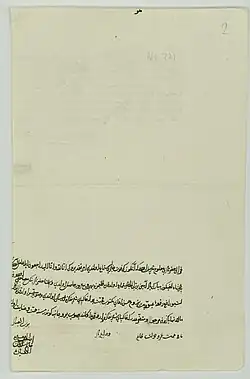
Mihrimah Sultan was also active in diplomacy. She corresponded with foreign rulers and acted as a mediator for political issues. For example, she mirrored letters from Hürrem Sultan to Sigismund II Augustus, the King of Poland and Grand Duke of Lithuania, sending messages through the same courier system that also carried letters from Sultan Suleiman and Rüstem Pasha. This practice allowed her to be directly involved in the empire’s foreign relations, demonstrating her ability to influence international affairs.[52]
After the death of Hürrem Sultan, Mihrimah became a close advisor and confidant to her father, Suleiman. She gave him advice on military campaigns and political strategies. One example is her encouragement for a campaign against Malta in 1565. Mihrimah promised to supply four hundred ships from her own resources to support the expedition. However, the campaign did not happen because Suleiman and his son Selim II decided to keep Admiral Piali Pasha in Istanbul due to family obligations. This shows Mihrimah’s willingness to use her personal wealth and influence to affect Ottoman military decisions.[54][56]
She also likely influenced Suleiman’s decision to campaign against Hungary in 1566. This campaign ended with Suleiman’s death at Szigetvár. Mihrimah’s political input in military matters reflects the important advisory role she had in strategic decisions, even though she did not personally lead troops. Her ability to speak with the sultan and advise on military matters shows her strong influence in political decision-making.[57]
Mihrimah Sultan also played a vital role in economic and social matters. In the 16th century, the Ottoman Empire sometimes faced poor harvests, food shortages, and temporary closures of grain markets. During such crises, citizens of the Dalmatian Republic of Ragusa turned to Mihrimah for help. She facilitated the supply of Ottoman grain to the republic, which helped the people survive difficult times. This action showed her influence over economic matters and her concern for subjects beyond the palace walls.[59] In 1565, during the Great Siege of Malta, several Ragusan ships participated in the Christian fleet, causing conflicts with Ottoman forces. In 1566, the Ragusan ambassadors petitioned Mihrimah to act as their protector, highlighting the trust foreign states placed in her and her role as a mediator between the Ottoman state and other powers.[60]
Mihrimah remained politically active even during the reign of her nephew Murad III. She lived in the Old Palace (Eski Saray), but her influence extended into the new sultan’s court. When Selim II became sultan, he relied on her for financial and political support. She lent him fifty thousand gold coins when he needed money and continued to advise him on state matters.[61] She also acted on behalf of foreign powers, such as the Ragusans, who requested her intervention with the sultan to protect their interests.[63]
Mihrimah Sultan used her wealth and connections to support her family, allies, and political partners. For instance, when her granddaughter Saliha Hanimsultan married Cığalazade Yusuf Sinan Pasha in 1576, she provided a large dowry that included gold and fine clothing. She also helped him against rivals in court, such as Safiye Sultan, Ferhad Pasha, and Damat Ibrahim Pasha, showing that she continued to be a powerful player in palace politics even in her later years.[64]
Overall, Mihrimah Sultan was one of the most politically active Ottoman princesses. She was involved in palace intrigues, advised sultans on military and political matters, mediated between foreign powers and the empire, managed economic crises, and protected her family’s interests. She used her intelligence, wealth, and royal connections to influence events both inside and outside the palace. Her political work demonstrates that Ottoman women, especially members of the royal family, could play important roles in governance and diplomacy, shaping the history of the empire for decades.
Her letters, actions, and the trust placed in her by foreign powers show that she was a respected and powerful figure in the Ottoman political system. Even though she lived much of her life in a male-dominated society, Mihrimah Sultan effectively used her status and skills to leave a lasting impact on politics, military campaigns, economic affairs, and diplomacy. She is remembered as a symbol of the political power and influence Ottoman princesses could achieve during the 16th century.[66][68]
Mosques and Charities
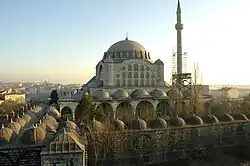
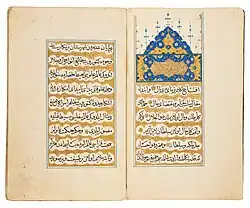
Mihrimah Sultan was not only a political figure but also a great supporter of architecture, education, and charity. She used her wealth and influence to fund many public projects in Istanbul and other parts of the Ottoman Empire. Many of her works were designed by her father’s chief architect, Mimar Sinan, who is considered one of the greatest architects in history. Her charitable and architectural works made her one of the most respected women of her time.[69] Her most famous contributions are the two large mosque complexes in Istanbul that bear her name. These complexes were not only places of worship but also centers for education, social service, and medical care, showing how she cared for both spiritual and worldly needs.
Mihrimah Sultan Mosque in Üsküdar
The first mosque is located in Üsküdar, a district on the Asian side of Istanbul. It is sometimes called the İskele Mosque, meaning “Pier Mosque.” The mosque was built between 1543 or 1544 and 1548. This mosque is a landmark of the city and is famous for its twin minarets. The mosque complex included several buildings for the benefit of the people. There was a mosque for daily prayers, a medrese where students could study Islamic sciences, a primary school, a soup kitchen to feed the poor, and a small clinic to provide medical care. This shows that Mihrimah Sultan wanted her works to help everyone, rich or poor. Today, some parts of the complex, like the primary school and medrese, are used as a modern outpatient clinic, continuing her tradition of helping the community.[69]
Mihrimah Sultan Mosque in Edirnekapı
The second mosque is located next to the Edirne Gate, or Edirnekapı, in the western walls of Istanbul. It was built later, between 1562 and 1565. Unlike the Üsküdar mosque, this one has only a single minaret. The complex also included a fountain for water, a medrese for education, and a hamam, or public bath. Mihrimah’s mosque complexes were not only religious centers but also played social and economic roles. They provided jobs for craftsmen, teachers, and servants. They also offered services to the poor, travelers, and students. By funding these projects, Mihrimah Sultan left a lasting mark on the city and showed the important role royal women could play in public life.[70][69]
Other Charitable Works
Mihrimah Sultan’s generosity extended beyond Istanbul. She funded the repair of the 'Ayn Zubaydah spring in Mecca, which was a very important water source for pilgrims visiting the holy city. She also established a foundation to supply wrought iron for the Ottoman navy, which helped the empire’s defense and trade. Her charitable work was a combination of religious duty, personal devotion, and political influence. By supporting mosques, schools, hospitals, and infrastructure, she strengthened both her own reputation and the empire’s stability. Her work showed that Ottoman royal women could actively participate in society, helping citizens and supporting the state at the same time.[69]
Death
Mihrimah Sultan died in Istanbul on 25 January 1578. She lived longer than all her siblings, outliving her brothers and sisters. Because of her close relationship with her father, Suleiman the Magnificent, she was the only child of his to be buried in his tomb at the Süleymaniye Mosque complex. This was a special honor, reflecting her importance in the family and the empire.[71][72][74]
Her death marked the end of an era. She had been an advisor, mediator, and influential figure for decades. From her father’s reign to her nephew Murad III, she had played a key role in politics, diplomacy, and public life. Even after her death, her architectural and charitable works continued to serve the people and inspire future generations.
Issue
Mihrimah Sultan had children with her husband Rüstem Pasha. Their children continued her legacy and helped maintain her family’s influence in the empire.
- Ayşe Hümaşah Sultan (1541–1604) – Their daughter married three times and had five sons and five daughters. She continued her mother’s legacy through her own family and maintained strong connections in the Ottoman court.[75]
- Sultanzade Osman Bey (1546–1576) – Their son was buried with his father in the Şehzade Mosque tomb. Although he died relatively young, he carried the family’s legacy and represented Mihrimah’s bloodline in the court.[77][78]
Mihrimah’s children maintained her influence in Ottoman politics and society. Through marriages, alliances, and their roles at court, they ensured that her family continued to be important in the empire even after her death.
Mihrimah Sultan’s life shows that an Ottoman princess could be a political advisor, diplomat, philanthropist, and public benefactor all at once. Her mosques, schools, charitable foundations, and family connections made her a central figure in 16th-century Ottoman society, and her legacy lasted long after her passing. Her work influenced architecture, social life, and politics, showing the wide-ranging power and responsibilities of royal Ottoman women.[69]
In literature and popular culture

Mihrimah Sultan has been remembered not only as a historical figure but also through art, literature, and television. Her life, beauty, and influence have made her a subject of interest both in Turkey and abroad.
Portraits and Art
One of the most famous artistic representations of Mihrimah Sultan is by the Italian painter Titian. The portrait, entitled Cameria, Daughter of Suleiman the Magnificent as St. Catherine, shows her dressed in European style and reflects how she was admired beyond the Ottoman Empire. Europeans called her Sultana Cameria, a variation of the Arabic name Qamariyyah, meaning “of the moon.”[79]
Television Portrayals
Mihrimah Sultan has been depicted in several Turkish TV series, introducing her story to modern audiences:
Literature
Mihrimah Sultan appears as a central character in novels inspired by Ottoman history:
- In The Architect's Apprentice, a 2014 novel by Elif Shafak, Mihrimah is depicted as a strong and influential princess who interacts with the empire's architects and leaders, highlighting her political and cultural role.[82][83]
- She is also featured in the Turkish book Hürrem ve Mihrimah Sultan: Haremin Gülü ve Goncası (Hürrem and Mihrimah Sultan: The Rose and the Rosebud of Harem) by Muhterem Yüceyılmaz, which explores her life and relationship with her mother Hürrem Sultan.[84]
Cultural Influence
Mihrimah Sultan's life has inspired historians, artists, and writers for centuries. She is remembered as a wise and politically active princess, who influenced the decisions of her father Sultan Suleiman, advised her husband Rüstem Pasha, and supported charitable and architectural works. In modern Turkey, her story continues to be retold in books, television, and public history projects, showing the continuing fascination with the women of the Ottoman court and the period of the Sultanate of Women.
Her name and image often appear in exhibitions about Ottoman art and architecture, and she is recognized for commissioning major projects like the Mihrimah Sultan Mosques in Istanbul, which further strengthened her legacy as a patron of culture and society.[6]
References
- ↑ Leslie Peirce (2017). Empress of the East. p. 58.
- ↑ Necdet Sakaoğlu (2007). Famous Ottoman Women. Avea. p. 105. ISBN 978-975-7104-77-3.
- ↑ Fen Fakültesi İstanbul Üniversitesi (1967). Lectures Delivered on the 511th Anniversary of the Conquest of İstanbul. Fen Fakültesi Döner Sermaye Basımevi. p. 13.
- ↑ Isom-Verhaaren 2016, p. 158.
- ↑ Arthur Stratton (1971). Sinan: The Biography of One of the World's Greatest Architects and a Portrait of the Golden Age of the Ottoman Empire. Scribner. p. 178. ISBN 978-0-684-12582-4.
- 1 2 Ekinci, Ekrem Buğra (11 March 2014). "Notable life of Mihrimah Sultan". Daily Sabah. Retrieved 20 February 2026.
- ↑ Giorgio Vasari; Francesco Priscianese; Pietro Aretino; Sperone Speroni; Lodovico Dolce (23 April 2019). Lives of Titian. Getty Publications. p. 97. ISBN 978-1-60606-587-7.
- ↑ David Geoffrey Alexander (2003). From the Medicis to the Savoias: Ottoman Splendour in Florentine Collections. Sabanci University, Sakip Sabanci Müzesi. p. 94. ISBN 978-975-8362-37-0.
- ↑ Nahrawālī & Blackburn 2005, p. 201 n. 547.
- ↑ Leslie Peirce (2017). Empress of the East. p. 58.
- 1 2 Peirce 1993, p. 60.
- ↑ Uluçay 1992, p. 65.
- 1 2 3 Yermolenko 2005, p. 235.
- ↑ Yermolenko 2005, p. 233.
- ↑ Vovchenko, Denis (18 July 2016). Containing Balkan Nationalism: Imperial Russia and Ottoman Christians, 1856-1914. Oxford University Press. p. 32. ISBN 978-0-19-061291-7.
- ↑ Isom-Verhaaren 2016, p. 154.
- ↑ Peirce 1993, p. 76.
- ↑ Tolga Uslubaş; Yılmaz Keskin (2007). Alfabetik Osmanlı tarihi ansiklopedisi. Karma Kitaplar. p. 393. ISBN 978-9944-321-50-1.
- ↑ Pars Tuğlacı (1985). Türkiyeʼde kadın. Cem Yayınevi. p. 316.
- ↑ Metin And (2009). 16. yüzyılda İstanbul: kent, saray, günlük yaşam. Yapı Kredi Yayınları. p. 145. ISBN 978-975-08-1832-5.
- 1 2 Uluçay 1992, p. 66.
- ↑ Miović 2018, p. 98.
- ↑ Peirce 1993, pp. 68, 76, 123.
- ↑ Miović 2018, p. 97.
- 1 2 3 4 5 Nahrawālī & Blackburn 2005, p. 82 n. 208.
- ↑ Peirce 1993, p. 72.
- ↑ Isom-Verhaaren 2016, p. 155.
- ↑ Hans Georg Majer; Sabine Prätor; Christoph K. Neumann (2002). Arts, women and, scholars. Simurg. p. 105. ISBN 978-975-7172-64-2.
Ayşe Sultan duhter-i hazret-i Mihrümāh Sulțān el-mezbūre zevce-i Ahmed Paşa
- 1 2 Atçıl 2020, p. 14.
- ↑ [29]
- ↑ Miović 2018, pp. 100–101.
- ↑ [31]
- ↑ Nahrawālī & Blackburn 2005, p. 158.
- ↑ [33]
- ↑ Nahrawālī & Blackburn 2005, p. 176.
- ↑ Nahrawālī & Blackburn 2005, p. 207.
- ↑ Uluçay 1992, p. 67.
- ↑ [37]
- 1 2 Atçıl 2020, p. 21.
- ↑ [39]
- ↑ Peirce 1993, p. 67.
- ↑ [41]
- ↑ Peirce 1993, p. 79.
- ↑ [43]
- ↑ Isom-Verhaaren 2016, p. 156.
- ↑ [45]
- ↑ Uluçay 1992, pp. 66–67.
- ↑ [47]
- ↑ Peirce 1993, p. 84.
- ↑ [49]
- ↑ Peirce 1993, p. 221.
- ↑ [51]
- 1 2 3 Miović 2018, p. 106.
- ↑ [53]
- ↑ Peirce 1993, pp. 68–69.
- ↑ [55]
- ↑ [53]
- ↑ Miović 2018, p. 102.
- ↑ [58]
- ↑ [53]
- ↑ [39]
- ↑ Miović 2018, p. 107.
- ↑ [62]
- ↑ Biçer, Merve (2014). Cigalazade Yusuf Sinan Pasha: A 16th Century Ottoman Convert in the Mediterranean World (Master Thesis). Department of History İhsan Doğramacı Bilkent University, Ankara. p. 48.
- ↑ Peirce 1993, p. 65.
- ↑ [65]
- ↑ Peirce 1993, pp. 127–128.
- ↑ [67]
- 1 2 3 4 5 Cite error: The named reference
Notable life of Mihrimah Sultan4was used but no text was provided for refs named (see the help page). - ↑ Cite error: The named reference
Mihrimahwas used but no text was provided for refs named (see the help page). - ↑ Türkiye Diyanet Vakfı (1988). İslâm ansiklopedisi: Mısra – Muhammediyye. Türkiye Diyanet Vakfı. p. 40. ISBN 978-975-389-402-9.
- ↑ Osman Gazi'den Sultan Vahidüddin Han'a Osmanlı tarihi. Çamlıca Basım Yayın. 2014. p. 120. ISBN 978-9944-905-39-8.
- ↑ Miović 2018, p. 108.
- ↑ [73]
- ↑ Dumas, Juliette (2013). Les perles de nacre du sultanat: Les princesses ottomanes (mi-XVe – mi-XVIIIe siècle). p. 60.
- ↑ Peirce 1993, p. 68.
- ↑ [76]
- ↑ [29]
- ↑ David Geoffrey Alexander (2003). From the Medicis to the Savoias: Ottoman Splendour in Florentine Collections. Sabanci University, Sakip Sabanci Müzesi. p. 94. ISBN 978-975-8362-37-0.
- ↑ "Hürrem Sultan (TV Series 2003)". IMDb. Retrieved 17 February 2024.
- ↑ "Muhteşem Yüzyıl's Mihrimah Sultan – Pelin Karahan". Star.com.tr (in Turkish). Retrieved 13 October 2017.
- ↑ Atamian, Christopher (8 June 2015). "'The Architect's Apprentice,' by Elif Shafak". The New York Times. ISSN 0362-4331. Retrieved 4 November 2017.
- ↑ "The Architect's Apprentice by Elif Shafak, book review". The Independent. London. 30 October 2014. Archived from the original on 14 May 2022. Retrieved 4 November 2017.
- ↑ Hürrem ve Mihrimah Sultan: Haremin Gülü ve Goncası Amazon
Bibliography
- Atçıl, Zahit (2020). "Osmanlı Hanedanının Evlilik Politikaları ve Mihrimah Sultan'ın Evliliği". Güneydoğu Avrupa Araştırmaları Dergis (34): 1–26.
- Isom-Verhaaren, Christine (11 April 2016). "Mihrimah Sultan: A Princess Constructs Ottoman Dynastic Identity". In Christine Isom-Verhaaren; Kent F. Schull (eds.). Living in the Ottoman Realm: Empire and Identity, 13th to 20th Centuries. Indiana University Press. ISBN 9780253019486.
- Miović, Vesna (2 May 2018). "Per favore della Soltana: moćne osmanske žene i dubrovački diplomati". Anali Zavoda za Povijesne Znanosti Hrvatske Akademije Znanosti i Umjetnosti u Dubrovniku (in Croatian). 56 (56/1): 147–197. doi:10.21857/mwo1vczp2y. ISSN 1330-0598.
- Nahrawālī, Muḥammad ibn Aḥmad; Blackburn, Richard (2005). Journey to the Sublime Porte: The Arabic Memoir of a Sharifian Agent's Diplomatic Mission to the Ottoman Imperial Court in the Era of Suleyman the Magnificent; the Relevant Text from Quṭb al-Dīn al-Nahrawālī's al-Fawāʼid al-sanīyah fī al-riḥlah al-Madanīyah wa al-Rūmīyah. Orient-Institut. ISBN 978-3-899-13441-4.
- Peirce, Leslie (1993). Imperial Harem: Women and Sovereignty in the Ottoman Empire. Oxford University Press. ISBN 0-19-508677-5.
- Uluçay, Mustafa Çağatay (1992). Padışahların kadınları ve kızları. Türk Tarihi Kurumu Yayınları.
- Yermolenko, Galina (2005). "Roxolana: The Greatest Empress of the East". The Muslim World. 95 (2): 231–248. doi:10.1111/j.1478-1913.2005.00088.x.
External links
