Methyl formate
| |||
 | |||
| Names | |||
|---|---|---|---|
| Preferred IUPAC name
Methyl formate | |||
| Systematic IUPAC name
Methyl methanoate | |||
| Other names
R-611 | |||
| Identifiers | |||
3D model (JSmol) |
|||
| ChEBI | |||
| ChEMBL | |||
| ChemSpider | |||
| ECHA InfoCard | 100.003.166 | ||
| EC Number |
| ||
PubChem CID |
|||
| UNII | |||
CompTox Dashboard (EPA) |
|||
SMILES
| |||
| Properties | |||
| C2H4O2 | |||
| Molar mass | 60.05 g·mol−1 | ||
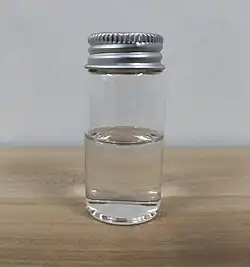
| Appearance | Colorless liquid | ||
| Odor | pleasant,[1] ethereal | ||
| Density | 0.98 g/cm3 | ||
| Melting point | −100 °C (−148 °F; 173 K) | ||
| Boiling point | 32 °C (90 °F; 305 K) | ||
| 30% (20°C)[1] | |||
| Vapor pressure | 634 hPa (476 mmHg) (20°C)[1] | ||
| −32.0·10−6 cm3/mol | |||
| Hazards | |||
| Occupational safety and health (OHS/OSH): | |||
Main hazards |
Can cause eye injury | ||
| GHS labelling:[2] | |||
Pictograms |
Template:GHS02Template:GHS07 | ||
Signal word |
Danger | ||
Hazard statements |
H224, H302, H319, H332, H335 | ||
Precautionary statements |
P210, P233, P240, P241, P242, P243, P261, P264, P270, P271, P280, P301+P312, P303+P361+P353, P304+P312, P304+P340, P305+P351+P338, P312, P330, P337+P313, P370+P378, P403+P233, P403+P235, P405, P501 | ||
| NFPA 704 (fire diamond) | |||
| Flash point | −19 °C; −2 °F; 254 K[1] | ||
| Explosive limits | 4.5%-23%[1] | ||
| Lethal dose or concentration (LD, LC): | |||
LD50 (median dose) |
1622 mg/kg (oral, rabbit)[3] | ||
LCLo (lowest published) |
50,000 ppm (guinea pig, 20 min)[3] | ||
| NIOSH (US health exposure limits): | |||
PEL (Permissible) |
TWA 100 ppm (250 mg/m3)[1] | ||
REL (Recommended) |
TWA 100 ppm (250 mg/m3) ST 150 ppm (375 mg/m3)[1] | ||
IDLH (Immediate danger) |
4500 ppm[1] | ||
| Safety data sheet (SDS) | Oxford MSDS | ||
Except where otherwise noted, data are given for materials in their standard state (at 25 °C [77 °F], 100 kPa). | |||
 verify (what is  ?) | |||
| Infobox references | |||
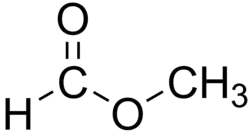
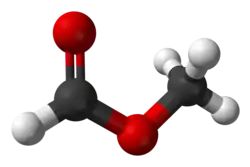

Methyl formate is an organic compound with the chemical formula HCO2CH3. It is the simplest ester of a carboxylic acid. Methyl formate is used as a chemical precursor to other formic acid derivatives.
Preparation
Industrially, methyl formate is made by carbonylation of methanol:
- CH3OH + CO → HCO2CH3
A strong base like sodium methoxide is used as a catalyst.
References
- 1 2 3 4 5 6 7 8 NIOSH Pocket Guide to Chemical Hazards. "#0417". National Institute for Occupational Safety and Health (NIOSH).
- ↑ "Methyl formate". pubchem.ncbi.nlm.nih.gov. Archived from the original on 19 December 2021. Retrieved 19 December 2021.
- 1 2 "Methyl formate". Immediately Dangerous to Life or Health Concentrations. National Institute for Occupational Safety and Health.