Mellitic anhydride
 | |
 | |
| Names | |
|---|---|
| Preferred IUPAC name
Benzo[1,2-c:3,4-c′:5,6-c′′]trifuran-1,3,4,6,7,9-hexone | |
| Identifiers | |
3D model (JSmol) |
|
| ChemSpider | |
PubChem CID |
|
| UNII | |
CompTox Dashboard (EPA) |
|
SMILES
| |
| Properties | |
| C12O9 | |
| Molar mass | 288.12 g·mol−1 |
| Appearance | colorless solid[1] |
| Melting point | 161 °C; 322 °F; 434 K[1] |
| Vapor pressure | 0.000004 mmHg (20°C)[1] |
| Hazards | |
| NIOSH (US health exposure limits): | |
PEL (Permissible) |
none[1] |
REL (Recommended) |
TWA 0.005 ppm (0.04 mg/m3) Should be handled in the workplace as an extremely toxic substance.[1] |
IDLH (Immediate danger) |
N.D.[1] |
Except where otherwise noted, data are given for materials in their standard state (at 25 °C [77 °F], 100 kPa). | |
 verify (what is  ?) | |
| Infobox references | |
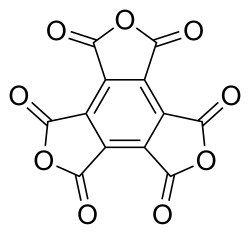
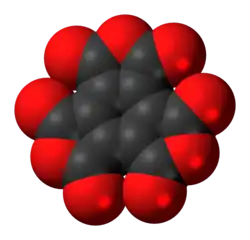
Mellitic anhydride is a chemical compound. It has the chemical formula C12O9.
Mellitic acid is a carbon oxide, in that it is only made of carbon and oxygen, but has a different chemical structure from simple carbon oxides like carbon dioxide. It is usually called an organic compound even though it does not meet many simple definitions of an organic compound like having carbon-hydrogen bonds.