MIUI
 | |
| Developer | Xiaomi |
|---|---|
| OS family | Android-like OS (Android-based Linux OS) |
| Source model | Open source (Modified Android Base and Main Framework) with Proprietary components (MIUI Apps and Kits)[1] |
| Initial release | 0.8.16 / 16 August 2010 |
| Latest release | Varies by mobile phone and region. |
| Latest preview | V14.0.23.10.8.DEV (Mainland China) / 17 August 2023 |
| Marketing target | Alternative OS replacement for Android devices; Stock firmware for Xiaomi smartphone and tablet |
| Available in | 77 languages (varies by country) |
| Package manager | APK-based |
| Platforms | ARMv7, ARM64, MIPS, x86, x64 |
| Kernel type | Monolithic (modified Linux kernel) |
| License | Proprietary |
| Succeeded by | Xiaomi HyperOS |
| Official website | www home |
MIUI (pronounced mee-yoo-eye) was a mobile operating system by Xiaomi for its smartphones and devices, from 2010 to 2023.[2][3][4] MIUI was based on the Android Open Source Project.
There are different versions for each Xiaomi phone model. Xiaomi have also released a few devices using Google's Android One instead of MIUI.[5][6]
Xiaomi is replacing MIUI with its new Android operating system named HyperOS, which was made with the Xiaomi 14 series.[7][8][9]
Version history
Old version, not maintained
Older version, still maintained
Current stable version
| Version | Screenshot | Android version | Date of release | Last Stable release | Notable change |
|---|---|---|---|---|---|
| MIUI V1 | [10] |
2.1 | 16 August 2010 | 0.8.16 |
|
| MIUI V2 | 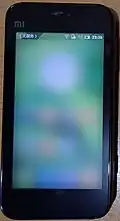 |
2.1-2.3.6 |
Unknown | N/a |
|
| MIUI V3 | 2.3.6 | Unknown | N/a |
| |
| MIUI V4 | 4.0.4 – 4.1.2 | Unknown | ICS24.0[11] |
| |
| MIUI V5 | 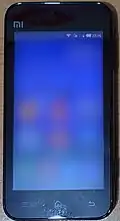 |
4.1.2 – 4.4.2 | 1 March 2013[12] | 31.0[13] |
|
| MIUI 6 | 4.4.2 – 5.0.2 | 29 August 2014[14] | 6.7.2.0 |
| |
| MIUI 7 | 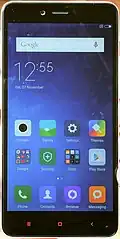 |
4.4.2 – 6.0.1 | 13 August 2015[15] | 7.5.9.0 |
|
| MIUI 8 | 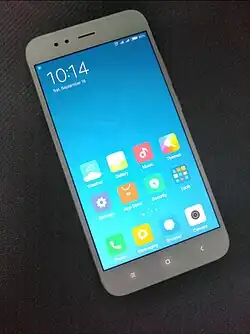 |
4.4.2 – 7.1.2 | 16 June 2016[16] | 8.5.10.0 |
|
| MIUI 9 |  |
4.4.2 – 8.1.0 | 10 August 2017 | 9.6.5.0 |
|
| MIUI 10 | 6.0 – 9 | 19 June 2018[17] | 10.4.5.0 |
| |
| MIUI 11 |  |
7.0 – 10 | 22 October 2019 | 11.0.14.0 |
|
| MIUI 12 | 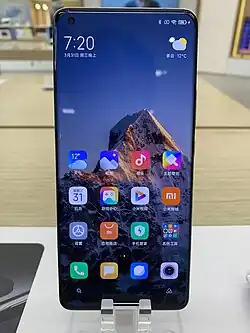 |
9 – 11 | 27 April 2020 | 12.2.7.0 |
|
| MIUI 12.5 |  |
10 – 12 | 28 December 2020 | 12.5.26.0 |
|
| MIUI 13 | 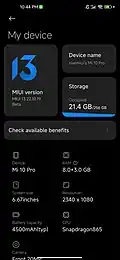 |
11 – 13 | 28 December 2021 | 13.2.8.0 (Mainland China) 13.2.6.0 (Global Market) |
|
| MIUI 14 | 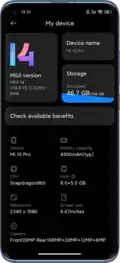 |
12 – 14 | 11 December 2022 | 14.1.10.0 |
|
| HyperOS[21] | 13 and above | 17 October 2023 | OS1.0.9.0.UMLCNXM (Mainland China) OS1.0.7.0.UNLCNXM (Global Market) |
| |
References
- ↑ "Mi OpenSource". github.com.
- ↑ Xiaomi 13 Quick Start Guide
- ↑ "小米科技的MIUI和手机_通讯与电讯_科技时代_新浪网". tech.sina.com.cn. Archived from the original on 2 February 2019. Retrieved 24 April 2012.
- ↑ MIUI Official English Site, en.miui.com, archived from the original on 15 February 2014, retrieved 16 March 2014
- ↑ "Xiaomi launches its first Android One smartphone, the Mi A1". Android Authority. 5 September 2017. Retrieved 12 April 2024.
- ↑ Singh, Manish (21 August 2019). "Xiaomi launches Mi A3 Android One smartphone with 48MP rear camera in India for $181". TechCrunch. Retrieved 12 April 2024.
- ↑ Davies, Hannah (20 October 2023). "What is HyperOS? Xiaomi's new Android software explained". Trusted Reviews. Retrieved 12 April 2024.
- ↑ "Xiaomi HyperOS: The Global Rollout Plan Unveiled". Gizchina.com. 6 November 2023. Retrieved 12 April 2024.
- ↑ Schoon, Ben (Oct 17 2023). "Xiaomi smartphones will now run 'HyperOS,' but it's still Android". 9to5google.com/. Retrieved 12 April 2024.
{{cite web}}: Check date values in:|date=(help) - ↑ "MIUI 14 锐意新生". home.miui.com. Retrieved 2023-12-09.
- ↑ "MIUI Official English Site - Redefining Android". 2013-12-06. Archived from the original on 2013-12-06. Retrieved 2018-05-22.
- ↑ Forum, Xiaomi MIUI Official. "MIUI ROM 3.3.1 Changelog: MIUI V5 for Xiaomi MI2 Released!!! - MIUI General - Xiaomi MIUI Official Forum". en.miui.com. Archived from the original on 11 February 2017. Retrieved 10 February 2017.
- ↑ Forum, Xiaomi MIUI Official. "MIUI Stable ROM (Global) KXDMIBF22.0 for MI3-WCDMA/CDMA Changelog & Download - Xiaomi Mi 3 - Xiaomi MIUI Official Forum". en.miui.com. Archived from the original on 6 May 2018. Retrieved 2018-05-05.
- ↑ Forum, Xiaomi MIUI Official. "MIUI ROM 4.8.29 Full Changelog. MIUI 6 Released for Public! (Released) - MIUI General - Xiaomi MIUI Official Forum". en.miui.com. Archived from the original on 11 February 2017. Retrieved 10 February 2017.
- ↑ Forum, Xiaomi MIUI Official. "About MIUI 7 China ROM 5.8.13. What Device Will MIUI 7 Global ROM Support First? - MIUI General - Xiaomi MIUI Official Forum". en.miui.com. Archived from the original on 11 February 2017. Retrieved 10 February 2017.
- ↑ Forum, Xiaomi MIUI Official. "MIUI 8 China Developer ROM 6.6.16 Full Changelog & Supported Devices - MIUI General - Xiaomi MIUI Official Forum". en.miui.com. Archived from the original on 11 February 2017. Retrieved 10 February 2017.
- ↑ "MIUI 10首批机型公测下载 - MIUI官方网站". www.miui.com. Archived from the original on 21 August 2017. Retrieved 2018-06-21.
- ↑ "MIUI 11 will introduce new icons, ultra power saving mode, and more". 29 March 2019. Archived from the original on 24 August 2021. Retrieved 5 April 2019.
- ↑ "MIUI 12.1 coming soon. Here are all the what's new! - Tech in Deep". www.techindeep.com. 15 July 2020. Archived from the original on 24 August 2021. Retrieved 2 August 2020.
- ↑ "MIUI Notes App has changed completely on MIUI 13!". www.xiaomiui.net. Archived from the original on 26 March 2022. Retrieved 9 April 2022.
- ↑ "Xiaomi unveils New operating system named 'HyperOS'". androidstory.net. 17 October 2023. Retrieved 17 October 2023.