List of heads of state of India
This is a list of the heads of state of India, from the time of independence of India in 1947 to present day. The current head of state of India is Droupadi Murmu, elected in 2022 after being nominated by the BJP and Prime Minister Narendra Modi.
From 1947 to 1950, the head of state under the Indian Independence Act 1947 was regarded as the king of India, who was also the Monarch of the United Kingdom and of the other Dominions of the British Commonwealth. The monarch was represented in India by a Governor-General. India became a republic under the Constitution of 1950 and the Monarch and Governor-General were replaced by a ceremonial President.
Grand Viziers of the Mughal Empire
| Portrait | Name | Hindi Name | Term of office | Notable events | Emperor | |
|---|---|---|---|---|---|---|
| Amir Nizamuddin Khalifa | अमीर निज़ामुद्दीन खलीफा | 21 April 1526 | 17 May 1540 | 1st Battle of Panipat
Battle of Khanwa |
Babur (1526 – 1530)
& Humayun (1530 – 1540) | |
| Qaracha Khan | क़राचा खान | 1540 | ? | He was a governor of Qandahar and Humayun appoint him as Grand-Vizier of the Mughal State. | Humayun (1530 – 1556) | |
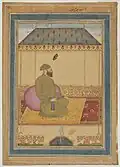 |
Bairam Khan[1] | बैरम खान | 1556 | March/April 1560 | Akbar-i-Azam اکبر اعظم (1556-1605) | |
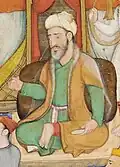 |
Munim Khan | मुनीम खान | 1560 | 1561 | ||
| Ataga Khan[2] | अतागा खान | November 1561 | 16 May 1562 | He was assassinated by Adham Khan | ||
| Muzaffar Khan Turbati[3] | मुज़फ़्फ़र ख़ान तुरबाती | 1575 | 1579 | No Vakil was appointed after his appointment to governorship in Bengal from 1579 until 1589 | ||
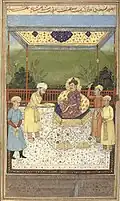 |
Abu'l-Fazl ibn Mubarak[4] | अबू-फ़ज़ल इब्न मुबारक | 1579 | 22 August 1602 | ||
| Sharif Khan[1] | शरीफ खान | 1605 | 1611 | Jahangir جہانگیر (1605-1627) | ||
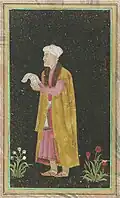 |
Mirza Ghias Beg[1] | मिर्ज़ा ग़ियास बेग | 1611 | 1622 | ||
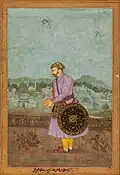 |
Abu'l-Hasan Asaf Khan[1] | अबुल-हसन आसफ खान | 1622 | 1627/28 |
| |
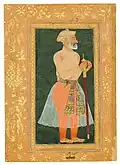 |
Shaikh Ilam-ud-Din Ansari[5] | शेख इलम-उद-दीन अंसारी | 1627 | 1628 (less than a year) | Shah Jahan شاہ جہان (1628-1658) | |
| Azam Khan[6] | आजम खान | 1628 | 1628 | |||
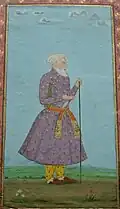 |
Afzal Khan Shirazi[1] | अफ़ज़ल खान शिराज़ी | 1628 | 1639 | ||
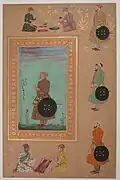 |
Islam Khan Mashadi[1] | इस्लाम खान मशादी | 1639 | 1645 | ||
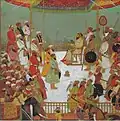 |
Sadullah Khan[7] | सादुल्लाह खान | 1645 | 1656 |
| |
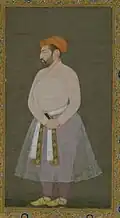 |
Mir Jumla[8] | मीर जुमला | 1656 | 1657 | Alamgir I عالمگیر (1658-1707) | |
| Jafar Khan[9] | जाफर खान | 1657 | 1658 | |||
| Fazil Khan[9] | फ़ाज़िल खान | 1658 | 1663 | |||
| Jafar Khan[8] | जाफर खान | 1663 | 1670 [10] | |||
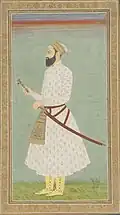 |
Asad Khan[11] | असद खान | 1675 | 1707 |
| |
| Mun'im Khan Khan-i-Khanan[12] | मुनीम खान खान-ए-खानान | 1707 | 1711 | Bahadur Shah I بہادر شاہ (1707-1712) | ||
| Hidayatullah Khan Kashmiri[13] | हिदायतुल्लाह खान कश्मीरी | 1711 | 1713 | Jahandar Shah جہاندار شاہ (1712-1713) | ||
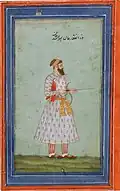 |
Zulfiqar Khan Nusrat Jung[14] | ज़ुल्फ़िकार ख़ान नुसरत जंग | 1712 | 1713 | ||
| Mir Rustam Ali Khan[1] | मीर रुस्तम अली खान | 1710 | 1737 | Farrukhsiyar فرخ سیر (1713–1719) | ||
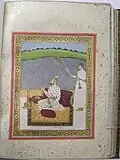 |
Qutb-ul-Mulk Abdullah Khan Barha[15] | कुतुब-उल-मुल्क अब्दुल्ला खान बरहा | 1713 | 1720 |
| |
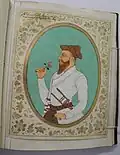 |
Muhammad Amin Khan Turani[15] | मुहम्मद अमीन खान तुरानी | 1720 | 1721 | Muhammad Shah محمد شاہ (1719-1748) | |
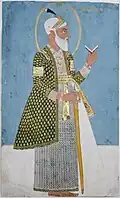 |
Mir Qamar-ud-Din Khan Asaf Jah I[17] | मीर कमर-उद-दीन खान आसफ जाह प्रथम | 1721 | 1723 | ||
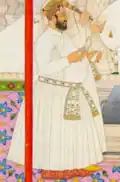 |
Roshan-ud-Daulah Zafar Khan[18][19] | रोशन-उद-दौला ज़फ़र ख़ान | 1724 | 1733 | ||
 |
Mir Fazil Qamar-ud-Din Khan | मीर फ़ाज़िल क़मर-उद-दीन ख़ान | 1733 | 1748 |
| |
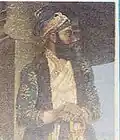 |
Safdar Jang[17] | सफदर जंग | 1748 | 1753 |
|
Ahmad Shah Bahadur احمد شاہ بہادر (1748-1754) |
| Intizam-ud-Daulah[20] | इंतिज़ाम-उद-दौला | 1753 | 1754 | |||
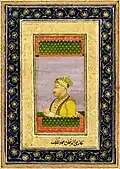 |
Imad-ul-Mulk Feroze Jung[20] | इमाद-उल-मुल्क फिरोज जंग | 1754 | 1760 | Alamgir II عالمگیر دوم (1754-1759) | |
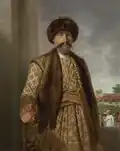 |
Shuja ud-Daulah[21] | शुजा उद-दौला | 1760
1760 |
1775
1784 |
|
Shah Alam II شاہ عالم دوم (1760-1806) |
| Najaf Quli Khan[22] | नजफ़ कुली खान | 1772 | 1791 | |||
Peshwas of the Maratha Empire
| Sr. | Portrait | Name | Native Name | Reign Began C.E. | Reign Ended C.E. |
|---|---|---|---|---|---|
| 1 | Moropant Trimbak Pingle | मोरोपंत त्रिम्बक पिंगले | 1674 | 1683 | |
| 2 | Nilakanth Moreshvar Pingale | नीलकंठ मोरेश्वर पिंगले | 1683 | 1689 | |
| 3 | 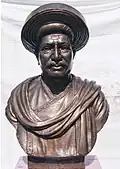 |
Ramchandra Pant Amatya | रामचंद्र पंत अमात्य | 1689 | 1708 |
| 4 | Bahiroji Pingale | बहिरोजी पिंगले | 1708 | 1711 | |
| 5 | Parshuram Trimbak Kulkarni | परशुराम त्र्यंबक कुलकर्णी | 1711 | 1713 | |
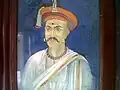 |
Balaji Vishwanath | बालाजी विश्वनाथ | 1713 | 1720 | |
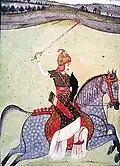 |
Baji Rao I | बाजीराव प्रथम | 1720 | 1740 | |
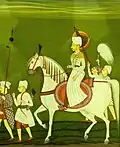 |
Balaji Bajirao | बालाजी बाजीराव | 1740 | 1761 | |
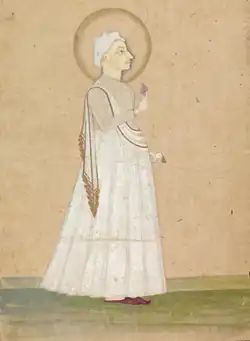 |
Madhav-Rao I | माधवराव प्रथम | 1761 | 1772 | |
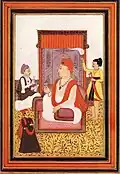 |
Narayan-Rao | नारायण राव | 1772 | 1773 | |
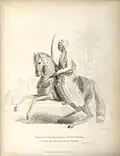 |
Raghunath-Rao | रघुनाथ राव | 1773 | 1774 | |
 |
Madhav-Rao II | माधव राव द्वितीय | 1774 | 1796 | |
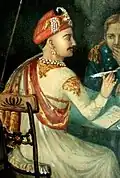 |
Baji Rao II | बाजीराव द्वितीय | 1796 | 1802 | |
| Amrut Rao[23][24] | अमृत राव | 1802 | 1803 | ||
|
Baji Rao II | बाजीराव द्वितीय | 1803 | 1851 | |
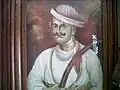 |
Nana Sahib | नाना साहब | 1851 | 1857 | |
Monarch (1947–1950)
The succession to the throne was the same as the succession to the British throne.
| № | Monarch (birth–death) |
Portrait | Reign | Royal House | Prime Minister | Governor General | |
|---|---|---|---|---|---|---|---|
| Reign start | Reign end | ||||||
| 1 | King George VI (1895–1952) |
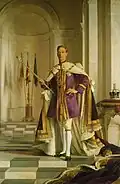 |
15 August 1947 | 26 January 1950 | Windsor | Nehru | Mountbatten (1947–1948) |
| Rajagopalachari (1948–1950) | |||||||
Governor-General
The Governor-General was the representative of the Monarch in India and exercised most of the powers of the Monarch. The Governor-General was appointed for an indefinite term, serving at the pleasure of the Monarch. After the passage of the Statute of Westminster 1931, the Governor-General was appointed solely on the advice of the Cabinet of India without the involvement of the British government. In the event of a vacancy the Chief Justice served as Officer Administering the Government.
| № | Governor-General (birth–death) |
Portrait | Tenure | Monarch | Prime Minister | |
|---|---|---|---|---|---|---|
| Took office | Left office | |||||
| 1 | The Rt. Hon. The Earl Mountbatten of Burma (1900–1979) |
 |
15 August 1947 | 21 June 1948 | George VI | Nehru |
| 2 | Chakravarti Rajagopalachari (1878–1972) |
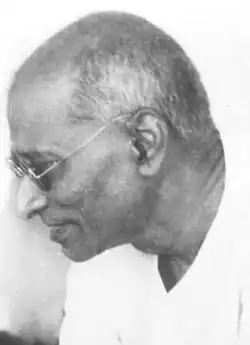 |
21 June 1948 | 26 January 1950 | ||
President (1950–present)
This list is numbered based on presidents elected after winning an Indian presidential election. The terms of V. V. Giri, Mohammad Hidayatullah and B. D. Jatti, who served as acting president, are therefore not numbered or counted as actual terms in office. The president of India does not represent any political party.
|
|
| Portrait | Name | Term of office[25] | Election | Vice president | Party | |||
|---|---|---|---|---|---|---|---|---|
 |
Rajendra Prasad | 26 January 1950 | 13 May 1962 | 12 years, 107 days | 1952 | Sarvepalli Radhakrishnan | Indian National Congress | |
| 1957 | ||||||||
 |
Sarvepalli Radhakrishnan | 13 May 1962 | 13 May 1967 | 5 years, 0 days | 1962 | Zakir Husain | Independent | |
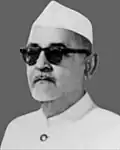 |
Zakir Husain† | 13 May 1967 | 3 May 1969 | 1 year, 355 days | 1967 | V. V. Giri | ||
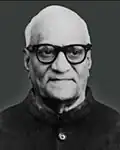 |
V. V. Giri | 3 May 1969 | 20 July 1969 | 78 days | – | |||
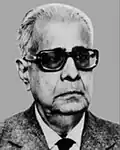 |
Mohammad Hidayatullah | 20 July 1969 | 24 August 1969 | 35 days | – | |||
|
V. V. Giri | 24 August 1969 | 24 August 1974 | 5 years, 0 days | 1969 | Gopal Swarup Pathak | Independent | |
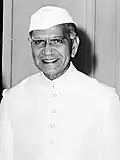 |
Fakhruddin Ali Ahmed† | 24 August 1974 | 11 February 1977 | 2 years, 171 days | 1974 | Gopal Swarup Pathak
|
Indian National Congress (R) | |
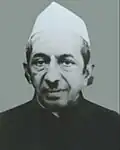 |
B. D. Jatti | 11 February 1977 | 25 July 1977 | 164 days | – | |||
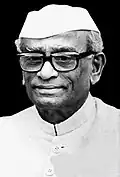 |
Neelam Sanjiva Reddy | 25 July 1977 | 25 July 1982 | 5 years, 0 days | 1977 | B. D. Jatti
|
Janata Party | |
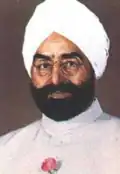 |
Zail Singh | 25 July 1982 | 25 July 1987 | 5 years, 0 days | 1982 | Mohammad Hidayatullah
|
Indian National Congress (I) | |
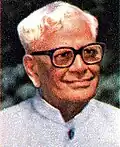 |
Ramaswamy Venkataraman | 25 July 1987 | 25 July 1992 | 5 years, 0 days | 1987 | Shankar Dayal Sharma | ||
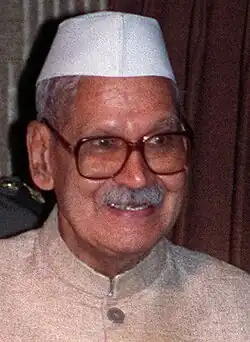 |
Shankar Dayal Sharma | 25 July 1992 | 25 July 1997 | 5 years, 0 days | 1992 | K. R. Narayanan | ||
 |
K. R. Narayanan | 25 July 1997 | 25 July 2002 | 5 years, 0 days | 1997 | Krishan Kant | ||
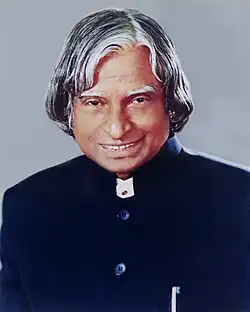 |
A. P. J. Abdul Kalam | 25 July 2002 | 25 July 2007 | 5 years, 0 days | 2002 | Krishan Kant
|
Independent | |
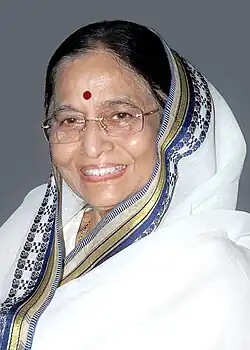 |
Pratibha Patil | 25 July 2007 | 25 July 2012 | 5 years, 0 days | 2007 | Hamid Ansari | Indian National Congress | |
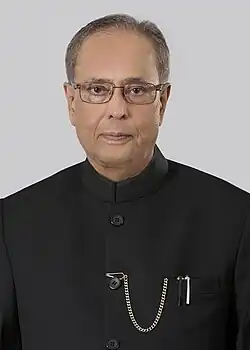 |
Pranab Mukherjee | 25 July 2012 | 25 July 2017 | 5 years, 0 days | 2012 | |||
 |
Ram Nath Kovind | 25 July 2017 | 25 July 2022 | 5 years, 0 days | 2017 | Hamid Ansari
|
Bharatiya Janata Party | |
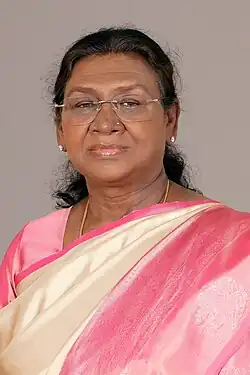 |
Droupadi Murmu | 25 July 2022 | Incumbent | 3 years, 339 days | 2022 | Venkaiah Naidu
| ||
References
- 1 2 3 4 5 6 7 Cite error: The named reference
auto1was used but no text was provided for refs named (see the help page). - ↑ Collier, Dirk (March 1, 2016). The Great Mughals and their India. Hay House, Inc. ISBN 9789384544980 – via Google Books.
- ↑ Satish Chandra (2005). Medieval India: From Sultanat to the Mughals Part - II. Har-Anand Publications. p. 136. ISBN 978-81-241-1066-9.
- ↑ Alfred J. Andrea, James H. Overfield (1998). The Human Record: To 1700. Houghton Mifflin. p. 476. ISBN 978-0-395-87087-7.
Abul Fazl(1551-1602), the emperor's chief advisor and confidant from 1579 until Abul Fazl's assassination at the instigation of Prince Salim, the future Emperor Jahangir(r. 1605-1627)
- ↑ Abraham Richard Fuller (1990). The Shah Jahan Nama of 'Inayat Khan: An Abridged History of the Mughal Emperor Shah Jahan). University of Michigan. p. 602. ISBN 978-0-19-562489-2.
- ↑ Abraham Richard Fuller (1990). The Shah Jahan Nama of 'Inayat Khan: An Abridged History of the Mughal Emperor Shah Jahan). University of Michigan. p. 602. ISBN 978-0-19-562489-2.
- ↑ Adolf Simon Waley (1927). The Shah Jahan Nama of 'Inayat Khan: An Abridged History of the Mughal Emperor Shah Jahan, Compiled by His Royal Librarian : the Nineteenth-century Manuscript Translation of A.R. Fuller (British Library, Add. 30,777). Constable.
- 1 2 Indian Institute of Public Administration (1976). The Indian Journal of Public Administration: Quarterly Journal of the Indian Institute of Public Administration, Volume 22. The Institute.
- 1 2 Indian History Congress - Proceedings: Volume 42. Indian History Congress. 1981.
- ↑ Indian History Congress Proceedings: Volume 42. Indian History Congress. 1981.
- ↑ Krieger-Krynicki, Annie (2005). Captive Princess: Zebunissa, Daughter of Emperor Aurangzeb. University of Michigan. ISBN 0195798376.
- ↑ Kaicker, Abhishek (3 Feb 2020). The King and the People: Sovereignty and Popular Politics in Mughal Delhi. Oxford University Press. ISBN 978-0190070687.
- ↑ William Irvine (1971). Later Mughals. p. 128.
- ↑ John F. Richards, The New Cambridge History of India: The Mughal Empire (New York: Cambridge University Press, 1993), p. 262
- 1 2 Encyclopaedia Britannica, Inc. (2009). Britannica Guide to India. Encyclopaedia Britannica, Inc. ISBN 978-1593398477.
- ↑ C. K. Srinivasan (1962). Baji Rao I, the Great Peshwa. p. 22.
- 1 2 Disha Experts (17 Dec 2018). The History Compendium for IAS Prelims General Studies Paper 1 & State PSC Exams 3rd Edition. Disha Publications. ISBN 978-9388373036.
- ↑ Praveen Kumar (2017). Complete Indian History for IAS Exam. Educreation Publishing. p. 267.
- ↑ Satish Chandra (1999). Medieval India: Mughal Empire, 1526-1748. Har-Anand Publications. ISBN 978-81-241-0522-1.
- 1 2 Khwaja, Sehar. "Fosterage and Motherhood in the Mughal Harem: Intimate Relations and the Political System in Eighteenth-Century India." Social Scientist 46, no. 5-6 (2018): 39-60. Accessed August 7, 2020. doi:10.2307/26530803.
- ↑ Bhatia, O. P. Singh (1968). History of India, from 1707 to 1856. Surjeet Book Depot.
- ↑ Rima Hooja (2006). A History of Rajasthan. the University of Michigan. p. 737. ISBN 978-81-291-0890-6.
- ↑ Wg Cdr (Retd.) Dr. M. S. Narawane, Battles of the Honourable East India Company. p. 65
- ↑ Jadunath Sarkar, Fall of the Mughal Empire:1789–1803. p. 179
- ↑ "The President of India". presidentofindia.gov.in. Retrieved 2021-10-29.