Leptodactylus watu
| Leptodactylus watu | |
|---|---|
Scientific classification  | |
| Kingdom: | Animalia |
| Phylum: | Chordata |
| Class: | Amphibia |
| Order: | Anura |
| Family: | Leptodactylidae |
| Genus: | Leptodactylus |
| Species: | L. watu |
| Binomial name | |
| Leptodactylus watu Alves da Silva, Magalhães, Thomassen, Leite, Garda, Brandão, Haddad, Giaretta, and Carvalho, 2020 | |
Home
Scientists see the frog on the dead leaves on the ground in forests that were never cut down and forests that are growing back. This frog does not live in grassy places or tree farms. Scientists saw the frog between 200 and 500 meters above sea level.[1]
Scientists saw the frog in a protected park: Parque Estadual Do Rio Doce.[1]
Young
The male frog sits under plants or on dead leaves on the ground or in holes in the ground and calls to the female frogs. The frog builds a nest out of bubbles underground for its eggs. When the rain falls, the water pushes tadpoles to pools of water, where they swim and grow.[1]
Danger
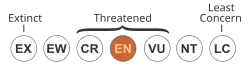
Scientists from the IUCN say this frog is in very big danger of dying out. Human beings change the places where the frog lives by changing forests to farms and tree farms, and places where animals eat grass. The forests that are there now are small and not next to each other.[1]
First paper
- Da Silva LA; FM Magalhães; H Thomassen; FSF Leite; AA Garda; RA Brandão; CFB Haddad; AA Giaretta; TR de Carvalho (2020). "Unraveling the species diversity and relationships in the Leptodactylus mystaceus complex (Anura: Leptodactylidae), with the description of three new Brazilian species". Zootaxa (Abstract). 4779: 151–189. doi:10.11646/zootaxa.4779.2.1. PMID 33055785. Retrieved January 16, 2026.
References
- 1 2 3 4 5 6 IUCN SSC Amphibian Specialist Group; Instituto Boitatá de Etnobiologia e Conservação da Fauna (2023). "Leptodactylus watu". IUCN Red List of Threatened Species. 2023: e.T179011343A199315721. doi:10.2305/IUCN.UK.2023-1.RLTS.T179011343A199315721.en. Retrieved January 16, 2026.
- ↑ Frost, Darrel R. "Leptodactylus watu Alves da Silva, Magalhães, Thomassen, Leite, Garda, Brandão, Haddad, Giaretta, and Carvalho, 2020". Amphibian Species of the World, an Online Reference. Version 6.0. American Museum of Natural History, New York. Retrieved January 16, 2026.
- ↑ "Leptodactylus watu Alves da Silva, Magalhães, Thomassen, Leite, Garda, Brandão, Haddad, Giaretta, & Carvalho, 2020". AmphibiaWeb. University of California, Berkeley. Retrieved January 16, 2026.