Leptodactylus wagneri
| Leptodactylus wagneri | |
|---|---|
 | |
Scientific classification  | |
| Kingdom: | Animalia |
| Phylum: | Chordata |
| Class: | Amphibia |
| Order: | Anura |
| Family: | Leptodactylidae |
| Genus: | Leptodactylus |
| Species: | L. wagneri |
| Binomial name | |
| Leptodactylus wagneri (Peters, 1862) | |
| Synonyms[2] | |
| |
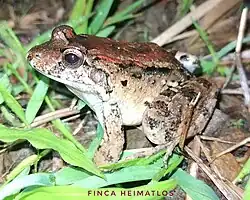
The Wagner's thin-toed frog, rana dedilarga de Wagner, or Wagner's white-lipped frog (Leptodactylus wagneri) is a frog. It lives in Peru, Brazil, Colombia, and Ecuador.[2][3][1]
Body
The adult male frog is 52.3–81.7 mm long from nose to rear end and the adult female frog is 38.0–57.6 mm long. This frog has cream and brown marks on its mouth. This frog has a mark on the back of its head in the shape of a triangle. The skin of the frog's back is olive-green, brown, or gray in color with dark marks. Sometimes there is some red color on the sides of the body. There is some yellow color where any of the four legs meet the body. The belly and throat are white in color. The iris of the eye is bronze in color with a gray-brown line in the middle and some black marks.[3]
Name
Scientists named the frog wagneri for the German scientist Dr. Moritz Wagner.[3]
Home
This frog lives in many kinds of places, for example marshes, swamps, forests that were never cut down, forests that are growing back, streams, lakes, and people's gardens. Scientists saw the frog between 200 and 1800 meters above sea level.[3] Scientists saw the frog in many protected places.[1]
Young
The female frog puts her eggs in a nest she makes out of bubbles. The tadpoles swim in water.[1]
Danger
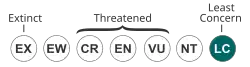
Scientists from the IUCN say this frog is not in danger of dying out. Human beings changed the places where the frog lives, but it is good at living in places that human beings have changed, for example people's gardens.[1]
References
- 1 2 3 4 5 IUCN SSC Amphibian Specialist Group (2023). "Wagner's White-lipped Frog: Leptodactylus wagneri". IUCN Red List of Threatened Species. 2023: e.T57175A85888854. doi:10.2305/IUCN.UK.2023-1.RLTS.T57175A85888854.en. Retrieved November 7, 2025.
- 1 2 Frost, Darrel R. "Leptodactylus wagneri (Peters, 1862)". Amphibian Species of the World, an Online Reference. Version 6.0. American Museum of Natural History, New York. Retrieved November 7, 2025.
- 1 2 3 4 Diego A. Ortiz; Morley Read; Andrea Varela-Jaramillo; Santiago R. Ron (October 23, 2013). Santiago R. Ron (ed.). "Leptodactylus wagneri (Peters, 1862)". AmphibiaWeb (in Spanish). University of California, Berkeley. Retrieved November 7, 2025.