Leptodactylus ventrimaculatus
| Leptodactylus ventrimaculatus | |
|---|---|
Scientific classification  | |
| Kingdom: | Animalia |
| Phylum: | Chordata |
| Class: | Amphibia |
| Order: | Anura |
| Family: | Leptodactylidae |
| Genus: | Leptodactylus |
| Species: | L. ventrimaculatus |
| Binomial name | |
| Leptodactylus ventrimaculatus Boulenger, 1902 | |
The spotted-venter thin-toed frog, Bulun white-lipped frog, spotted-vented thin-toed frog, rana terrestre mugidora , or rana dedilarga de vientre punteado (Leptodactylus ventrimaculatus) is a frog. It lives in Colombia, Peru, and Ecuador. Scientists think it might also live in Bolivia.[2][3][1]
Body
The adult male frog is 47.9–55.4 mm long from nose to rear end and the adult female frog is 44.8–59.3 mm long. The skin of the frog's back can have cream-yellow color and dark brown marks. The sides of the body can be dark brown, red-brown, or light rbown. There are some marks over the eyes.[3]
Home
These frogs are awake at night.[3] These frogs live in forests near streams. It can also live in places that human beings have changed, for example places where cows eat grass and forestst that were cut down and are growing back. Scientists saw the frog as high as 1400 meters above sea level.[1]
Young
The frogs put their eggs on low plants. The tadpoles swim in water.[1]
Danger
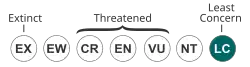
Scientists from the IUCN say this frog is not in danger of dying out. It is good at living in places where human beings have cut down the trees.[1]
References
- 1 2 3 4 5 IUCN SSC Amphibian Specialist Group (2019). "San Miguel Island Frog: Leptodactylus ventrimaculatus". IUCN Red List of Threatened Species. 2019: e.T57173A85888740. doi:10.2305/IUCN.UK.2019-3.RLTS.T57173A85888740.en. Retrieved November 21, 2025.
- ↑ Frost, Darrel R. "Leptodactylus ventrimaculatus Boulenger, 1902". Amphibian Species of the World, an Online Reference. Version 6.0. American Museum of Natural History, New York. Retrieved November 21, 2025.
- 1 2 3 Santiago R. Ron; Andrea Varela-Jaramillo; Morley Read; Gabriela Pazmiño-Armijos (September 21, 2013). Santiago R. Ron (ed.). "Leptodactylus ventrimaculatus Boulenger, 1902". AmphibiaWeb (in Spanish). University of California, Berkeley. Retrieved November 21, 2025.