Leptodactylus turimiquensis
| Leptodactylus turimiquensis | |
|---|---|
Scientific classification  | |
| Kingdom: | Animalia |
| Phylum: | Chordata |
| Class: | Amphibia |
| Order: | Anura |
| Family: | Leptodactylidae |
| Genus: | Leptodactylus |
| Species: | L. turimiquensis |
| Binomial name | |
| Leptodactylus turimiquensis Heyer, 2005 | |
The calf frog (Leptodactylus turimiquensis) is a frog. It lives in Venezuela.[2][3][1]
Home
This frog lives near plants. It is awake at night and hides in holes in the ground during the day. Sometimes people find it in gardens, so scientists think it might be good at living in places that human beings have changed. Scientists have seen it between 50 and 600 meters above sea level.[1]
Scientists have seen these frogs in protected places: Península de Paria National Park, Turuépano National Park, Mochima National Park, and Turimiquire Massif protected place.[1]
Young
The frog makes a nest out of bubbles for its eggs. The female frog digs a shallow hole for the foam nest. After the eggs hatch, the tadpoles fall into water.[1]
Danger
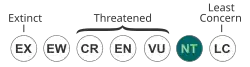
Scientists from the IUCN say this frog is in some danger of dying out. People change the place where the frog lives by cutting down many trees, even inside Peninsual de Paria National Park. But this does not happen in all of the park or all of the frog's home. People cut down forests to build farms for tannia, Colocasia esculenta, cocoa, and coffee. Some of these frogs are in danger from oil drilling.[1]
First paper
- Heyer WR (2005). "Variation and taxonomic clarification of the large species of the Leptodactylus pentadactylus species group (Amphibia: Leptodactylidae) from Middle America, Northern South America, and Amazonia". Arquivos de Zoologia (Full text). 37 (3): 269–348. doi:10.11606/issn.2176-7793.v37i3p269-348. Retrieved January 1, 2026.
References
- 1 2 3 4 5 6 Rivas, G.; Señaris, J.C.; La Marca, E. (2022) [amended version of 2020 assessment]. "Rana Picúa: Leptodactylus turimiquensis". IUCN Red List of Threatened Species. 2022: e.T136133A198658606. doi:10.2305/IUCN.UK.2022-1.RLTS.T136133A198658606.en. Retrieved December 31, 2025.
- ↑ Frost, Darrel R. "Leptodactylus turimiquensis Heyer, 2005". Amphibian Species of the World, an Online Reference. Version 6.0. American Museum of Natural History, New York. Retrieved December 31, 2025.
- ↑ "Rana Picúa: Leptodactylus turimiquensis Heyer, 2005". AmphibiaWeb. University of California, Berkeley. Retrieved December 31, 2025.