Leptodactylus stenodema
| Leptodactylus stenodema | |
|---|---|
Scientific classification  | |
| Kingdom: | Animalia |
| Phylum: | Chordata |
| Class: | Amphibia |
| Order: | Anura |
| Family: | Leptodactylidae |
| Genus: | Leptodactylus |
| Species: | L. stenodema |
| Binomial name | |
| Leptodactylus stenodema Jiménez de la Espada, 1875 | |
| Synonyms[2] | |
| |
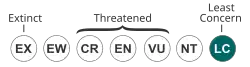
The Popoco thin-toed frog, San Jose white-lipped frog, rana terrestre de Moti, or rana dedilarga popoco (Leptodactylus stenodema) is a frog. It lives in Brazil, Colombia, Ecuador, Peru, Suriname, French Guiana, and Guyana. Scientists think it might also live in Bolivia.[2][3][1]
Body
The adult male frog is 83.0–99.7 mm long from nose to rear end and the adult female frog is 82.0–100.3 mm long. The skin of the frog's back is rose-brown, yellow-brown, or green-brown in color with small dark marks. The sides of the body are brown in color. The throat is gray or purple-gray or dark brown in color. The tops of the legs are gray-brown in color with lines. The iris of the eye is bronze in color on top and yellow on the bottom with a red line in between.[3]
Home
These frogs live in tropical rainforests, both rainforests that were never cut down and rainforests that were cut down and are growing back and in clearings in the forests. Scientists saw the frog between 0 and 1200 meters above sea level.[1]
Scientists saw the frog in many protected places.[1]
Young
The frog makes a nest out of bubbles for the eggs.[1]
Danger
Scientists from the IUCN say this frog is not in danger of dying out. In some places, frogs might be in danger when human beings change the places where the frog lives to make farms or get wood to build with.[1]
References
- 1 2 3 4 5 6 IUCN SSC Amphibian Specialist Group (2023). "San Jose White-lipped Frog: Leptodactylus stenodema". IUCN Red List of Threatened Species. 2023: e.T57168A85888344. doi:10.2305/IUCN.UK.2023-1.RLTS.T57168A85888344.en. Retrieved November 20, 2025.
- 1 2 Frost, Darrel R. "Leptodactylus stenodema Jiménez de la Espada, 1875". Amphibian Species of the World, an Online Reference. Version 6.0. American Museum of Natural History, New York. Retrieved November 20, 2025.
- 1 2 Diego A. Ortiz; Morley Read; Andrea Varela-Jaramillo; Santiago R. Ron (August 17, 2018). Santiago R. Ron (ed.). "Leptodactylus stenodema Jiménez de la Espada, 1875". AmphibiaWeb (in Spanish). University of California, Berkeley. Retrieved November 20, 2025.