Leptodactylus spixi
| Leptodactylus spixi | |
|---|---|
 | |
Scientific classification  | |
| Kingdom: | Animalia |
| Phylum: | Chordata |
| Class: | Amphibia |
| Order: | Anura |
| Family: | Leptodactylidae |
| Genus: | Leptodactylus |
| Species: | L. spixi |
| Binomial name | |
| Leptodactylus spixi Heyer, 1983 | |
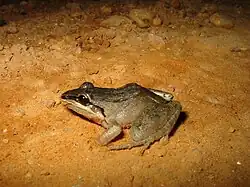
Spix's white-lipped frog (Leptodactylus spixi) is a frog. It lives in Brazil.[1][2][3]
Home
This frog lives in forests and next to forests in marshes and other wet places. Scientists have seen the frog between 0 and 900 meters above sea level.[3]
Scientists have seen the frog in some protected places.[3]
Young
This frog digs holes. The female frogs lay eggs in a nest made out of bubbles in the holes. When the rain falls, it fills the holes, and the tadpoles can go to pools of water to grow.[3]
Danger
Scientists from the IUCN say this frog is not in danger of dying out now. In the places where frog lives and used to live, human beings cut down many trees to get wood to use. Then people made towns and farms and places for animals to eat grass.[3]
References
- ↑ Frost, Darrel R. "Leptodactylus spixi Heyer, 1983". Amphibian Species of the World, an Online Reference. Version 6.0. American Museum of Natural History, New York. Retrieved December 18, 2025.
- ↑ "Leptodactylus spixi Heyer, 1983". AmphibiaWeb. University of California, Berkeley. Retrieved December 18, 2025.
- 1 2 3 4 5 IUCN SSC Amphibian Specialist Group (2023). "Spix's White-lipped Frog: Leptodactylus spixi". IUCN Red List of Threatened Species. 2023: e.T179011130A172225410. doi:10.2305/IUCN.UK.2023-1.RLTS.T179011130A172225410.en. Retrieved December 18, 2025.