Leptodactylus silvanimbus
| Leptodactylus silvanimbus | |
|---|---|
Scientific classification  | |
| Kingdom: | Animalia |
| Phylum: | Chordata |
| Class: | Amphibia |
| Order: | Anura |
| Family: | Leptodactylidae |
| Genus: | Leptodactylus |
| Species: | L. silvanimbus |
| Binomial name | |
| Leptodactylus silvanimbus McCranie, Wilson, and Porras, 1980 | |
The Honduras white-lipped frog (Leptodactylus silvanimbus) is a frog. It lives in Honduras.[2][3][1]
Body
The adult male frog is 41-55 mm long from nose to rear end and the adult female frog is 44-48 mm long. The adult male frog has a black spike on each front foot. The skin of the frog's back is gray-brown in color. The belly is cream-white in color.[3]
Name
Scientists named this frog silvanimbus for the place where it lives. Silva is Latin for "forest," and nimbus is Latin for "cloud."[3]
Home
This frog lives in forests, ponds, flooded places, and places where animals eat grass. Scientists have seen the frog between 1470 and 2000 meters above sea level.[1]
Scientists have seen the frog in one protected place La Reserva el Güisayote. The frog lives near Parque Nacional Celaque.[1]
Young
The female frog lays eggs in a nest made out of bubbles in puddles, where the tadpoles swim and grow.[1] The tadpoles can be 42-53 mm long. They are brown-gray in color and their tails are clear with brown dots.[3]
Danger
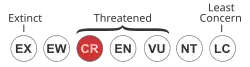
Scientists from the IUCN say this frog is in very big danger of dying out. It is good at living in plaes that people have changed, but chemicals that kill weeds and pests can kill this frog. Human beings built a road through the place where the frog lives, which can kill frogs. Sometimes scientists find tadpoles whose mouths are the wrong shape. This sometimes means that the frogs have touched bad chemicals or the dangerous disease chytridiomycosis.[1]
Climate change can also hurt this frog. Frogs that live high above sea level can only live in a few places. If their homes change too fast, the frogs will die or not be able to have young.[1]
References
- 1 2 3 4 5 6 7 IUCN SSC Amphibian Specialist Group (2020). "Honduras White-lipped Frog: Leptodactylus silvanimbus". IUCN Red List of Threatened Species. 2020: e.T57166A54371916. doi:10.2305/IUCN.UK.2020-3.RLTS.T57166A54371916.en. Retrieved December 15, 2025.
- ↑ Frost, Darrel R. "Leptodactylus silvanimbus McCranie, Wilson, and Porras, 1980". Amphibian Species of the World, an Online Reference. Version 6.0. American Museum of Natural History, New York. Retrieved December 15, 2025.
- 1 2 3 4 Elizabeth Reisman (October 6, 2003). Kellie Whittaker (ed.). "Leptodactylus silvanimbus McCranie, Wilson, and Porras, 1980". AmphibiaWeb. University of California, Berkeley. Retrieved December 15, 2025.