Leptodactylus savagei
| Leptodactylus savagei | |
|---|---|
 | |
Scientific classification  | |
| Kingdom: | Animalia |
| Phylum: | Chordata |
| Class: | Amphibia |
| Order: | Anura |
| Family: | Leptodactylidae |
| Genus: | Leptodactylus |
| Species: | L. savagei |
| Binomial name | |
| Leptodactylus savagei Heyer, 2005 | |
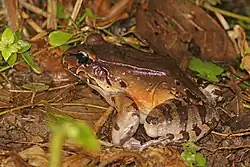
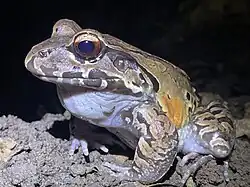
The smoky jungle frog, Central American bullfrog, Savage's thin-toed frog, rana toro, or rana ternero (Leptodactylus savagei) is a frog. It lives in Colombia, Costa Rica, Honduras, Panama, and Nicaragua.[2][3][1][4]
Other animals
Scientists believe that small insects that want to bite the frog and drink its blood find it by listening to its call.[3]
Home
Scientists saw the frog in many places, for example forests that have never been cut down and forests that are growing back. Scientists saw the frog between 0 and 1200 meters above sea level.[2][1]
Scientists believe the frog also lives inside protected places.[1]
Young
The male frog sits near water and calls to the female frogs. The tadpoles are big. They swim in streams, ponds, swamps, and people see them in nests made out of bubbles and in holes that the frogs dig.[1]
Danger
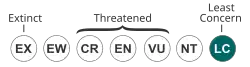
Scientists from the IUCN say this frog is least concern of dying out.[1]
References
- 1 2 3 4 5 6 IUCN SSC Amphibian Specialist Group (2020). "Savage's Thin-toed Frog: Leptodactylus savagei". IUCN Red List of Threatened Species. 2020: e.T136079A54357258. doi:10.2305/IUCN.UK.2020-1.RLTS.T136079A54357258.en. Retrieved January 6, 2026.
- 1 2 Frost, Darrel R. "Leptodactylus savagei Heyer, 2005". Amphibian Species of the World, an Online Reference. Version 6.0. American Museum of Natural History, New York. Retrieved January 6, 2026.
- 1 2 Michelle S. Koo, ed. (February 6, 2022). "Leptodactylus savagei Heyer, 2005". AmphibiaWeb. University of California, Berkeley. Retrieved January 6, 2026.
- ↑ Heyer WR (2005). "Variation and taxonomic clarification of the large species of the Leptodactylus pentadactylus species group (Amphibia: Leptodactylidae) from Middle America, Northern South America, and Amazonia". Arquivos de Zoologia (Full text). 37: 269–348. doi:10.11606/issn.2176-7793.v37i3p269-348. Retrieved January 5, 2026.