Leptodactylus rugosus
| Leptodactylus rugosus | |
|---|---|
Scientific classification  | |
| Kingdom: | Animalia |
| Phylum: | Chordata |
| Class: | Amphibia |
| Order: | Anura |
| Family: | Leptodactylidae |
| Genus: | Leptodactylus |
| Species: | L. rugosus |
| Binomial name | |
| Leptodactylus rugosus Noble, 1923 | |
| Synonyms[2] | |
| |
The Guyana white-lipped frog or rugose thin-toed frog (Leptodactylus rugosus) is a frog. It lives in Brazil, Venezuela, and Guyana.[2][3][1]
Body
This is a medium-sized frog. The adult male frogs have dark voice bags on their throats that they use to call. Male and female frogs have spines on their bodies, but males have more. These frogs have spots on their backs.[3]
Home
The adult frogs are awake at night and the young frogs are awake during the day and at night. It lives in rocky, sandy places and in rainforests nearby. It sometimes lives on table-shaped land. Scientists saw the frog between 230 and 2100 meters above sea level.[1]
Scientists saw the frog in some protected places: Kaieteur National Park and Parque Nacional Canaima.[1]
Young
The frog makes a nest out of bubbles for its eggs. It puts the nest and eggs in shallow water. Scientists see the tadpoles swimming or moving on wet rocks.[1] The tadpoles are brown in color with cream-white spots on their throats.[3]
Danger
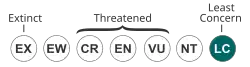
Scientists from the IUCN and the Venezuela Red List say this frog is not in fclittle danger of dying out. The frogs might be in some danger when people dig good rocks out of the ground.[1]
References
- 1 2 3 4 5 6 IUCN SSC Amphibian Specialist Group (2020). "Leptodactylus rugosus". IUCN Red List of Threatened Species. 2020: e.T57164A109540670. doi:10.2305/IUCN.UK.2020-3.RLTS.T57164A109540670.en. Retrieved November 25, 2025.
- 1 2 Frost, Darrel R. "Leptodactylus rugosus Noble, 1923". Amphibian Species of the World, an Online Reference. Version 6.0. American Museum of Natural History, New York. Retrieved November 25, 2025.
- 1 2 3 Elizabeth Reisman (November 14, 2003). Elizabeth Reisman (ed.). "Leptodactylus rugosus Noble, 1923". AmphibiaWeb. University of California, Berkeley. Retrieved November 25, 2025.