Leptodactylus rhodomerus
| Leptodactylus rhodomerus | |
|---|---|
 | |
Scientific classification  | |
| Kingdom: | Animalia |
| Phylum: | Chordata |
| Class: | Amphibia |
| Order: | Anura |
| Family: | Leptodactylidae |
| Genus: | Leptodactylus |
| Species: | L. rhodomerus |
| Binomial name | |
| Leptodactylus rhodomerus Heyer, 2005 | |
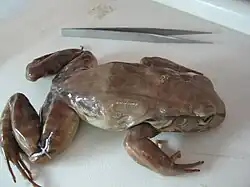
The rose thigh thin-toed frog, red-thighed thin-toed frog, rana terrestre de muslos rojos, or rana dedilarga muslos roseados (Leptodactylus rhodomerus) is a frog. It lives in Ecuador and Colombia.[2][3][1]
Body
The adult male frog is 112.2–143.8 mm long from nose to rear end and the adult female frog is about 133.5–157.8 mm long. This frog has a large body.
There are three dark marks on the upper mouth that make a triangle. The skin of the frog's back is brown with a makr between the eyes.[3]
Home
This frog is awake at night.[3] Scientists saw the frog in rainforests and in Chaco places. Sometimes people see it in places that human beings have changed, for example places where animals eat grass. Scientists saw the frog between 0 and 1100 meters above sea level.[1]
Scientists saw the frog inside some protected places: Reserva Ecológica Cotacachi-Cayapas, Reserva Ecológica Mache Chindul, Reserva Tesoro Escondido, Estación Biológica Bilsa, Reserva Río Canandé, Reserva Awa, and Parque Nacional Los Katíos. Scientists believe it could live in many more.[1]
People
Human beings sometimes catch this frog to eat it.[1]
Young
Scientists say this frog has young in streams in forests.[1]
Danger
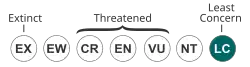
Scientists from the IUCN say this frog is not in danger of dying out. People cut down the forest where it lives to get wood to build with and make farms. Bad chemicals in rivers also hurt this frog.[1]
First paper
- Heyer WR (2005). "Variation and taxonomic clarification of the large species of the Leptodactylus pentadactylus species group (Amphibia: Leptodactylidae) from Middle America, Northern South America, and Amazonia". Arquivos de Zoologia (Full text). 37: 269–348. doi:10.11606/issn.2176-7793.v37i3p269-348. Retrieved January 6, 2026.
References
- 1 2 3 4 5 6 7 IUCN SSC Amphibian Specialist Group; Instituto Boitatá de Etnobiologia e Conservação da Fauna (2023). "Red-thighed Thin-toed Frog: Leptodactylus rhodomerus". IUCN Red List of Threatened Species. 2023: e.T136050A85906081. doi:10.2305/IUCN.UK.2023-1.RLTS.T136050A85906081.en. Retrieved January 6, 2026.
- ↑ Frost, Darrel R. "Leptodactylus peritoaktites Heyer, 2005". Amphibian Species of the World, an Online Reference. Version 6.0. American Museum of Natural History, New York. Retrieved January 6, 2026.
- 1 2 3 Morley Read; Andrea Varela-Jaramillo; Santiago Ron; Gabriela Pazmiño-Armijos (September 26, 2022). Santiago Ron (ed.). "Leptodactylus rhodomerus Heyer, 2005". AmphibiaWeb (in Spanish). University of California, Berkeley. Retrieved January 6, 2026.