Leptodactylus pustulatus
| Leptodactylus pustulatus | |
|---|---|
Scientific classification  | |
| Kingdom: | Animalia |
| Phylum: | Chordata |
| Class: | Amphibia |
| Order: | Anura |
| Family: | Leptodactylidae |
| Genus: | Leptodactylus |
| Species: | L. pustulatus |
| Binomial name | |
| Leptodactylus pustulatus (Peters, 1870) | |
| Synonyms[2] | |
| |
The Ceara white-lipped frog (Leptodactylus pustulatus) is a frog. It lives in Brazil.[2][3][1]
Home
These frogs live in Amazonia, Caatinga, and Cerrado places. People see it in grassy places, forests that grow next to rivers, places where animals eat grass, ponds, towns, and rivers. It is good at living in places that human beings have changed. Scientists saw the frog between 400 and 1000 meters above sea level.[1]
Scientists saw the frog in many protected places: APA da Serra de Baturite, APA de Upaon-Acu/Miritiba/Alto Preguicas, APA Lago de Palmas, APA Lago de Santa Isabel, APA Serra da Ibiapaba, and RESEX Lago do Cedro.[1]
Young
After the eggs hatch, the female frog carries the tadpoles to water.[1]
Danger
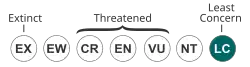
Scientists from the IUCN say this frog is not in danger of dying out because it lives in a large place. But it is in some danger. Human beings changed the places where the frog lives. Scientists found the dangerous fungus Batrachochytrium dendrobatidis on one of these frogs, but they don't know if the disease chytridiomycosis kills many of these frogs.[1]
References
- 1 2 3 4 5 6 IUCN SSC Amphibian Specialist Group; Instituto Boitatá de Etnobiologia e Conservação da Fauna (2023). "Ceara White-lipped Frog: Leptodactylus pustulatus". IUCN Red List of Threatened Species. 2023: e.T57159A173864821. doi:10.2305/IUCN.UK.2023-1.RLTS.T57159A173864821.en. Retrieved November 9, 2025.
- 1 2 Frost, Darrel R. "Leptodactylus pustulatus (Peters, 1870)". Amphibian Species of the World, an Online Reference. Version 6.0. American Museum of Natural History, New York. Retrieved November 9, 2025.
- ↑ "Leptodactylus pustulatus (Peters, 1870)". AmphibiaWeb. University of California, Berkeley. Retrieved November 9, 2025.