Leptodactylus paranaru
| Leptodactylus paranaru | |
|---|---|
Scientific classification  | |
| Kingdom: | Animalia |
| Phylum: | Chordata |
| Class: | Amphibia |
| Order: | Anura |
| Family: | Leptodactylidae |
| Genus: | Leptodactylus |
| Species: | L. paranaru |
| Binomial name | |
| Leptodactylus paranaru Magalhães, Lyra, Carvalho, Baldo, Brusquetti, Burella, Colli, Gehara, Giaretta, Haddad, Langone, López, Napoli, Santana, de Sá, and Garda, 2020 | |
Home
Scientists see the frog in forests, grassy places, and bodies of water that dry up for part of the year. Scientists saw the frog between 0 and 500 meters above sea level.[1]
There are protected parks where the frog lives[1]
Young
These frogs have young in bodies of water that dry up for part of the year. The frog builds a nest out of bubbles for its eggs. It puts the nest on the top of the water.[1]
Danger
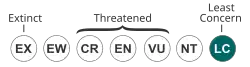
Scientists from the IUCN say this frog is not in danger of dying out. In some places, human beings change the places where the frog lives.[1]
References
- 1 2 3 4 5 6 IUCN SSC Amphibian Specialist Group; Instituto Boitatá de Etnobiologia e Conservação da Fauna (2023). "Leptodactylus paranaru". IUCN Red List of Threatened Species. 2023: e.T194294290A198515834. doi:10.2305/IUCN.UK.2023-1.RLTS.T194294290A198515834.en. Retrieved January 15, 2026.
- ↑ Frost, Darrel R. "Leptodactylus paranaru Magalhães, Lyra, Carvalho, Baldo, Brusquetti, Burella, Colli, Gehara, Giaretta, Haddad, Langone, López, Napoli, Santana, de Sá, and Garda, 2020". Amphibian Species of the World, an Online Reference. Version 6.0. American Museum of Natural History, New York. Retrieved January 15, 2026.