Leptodactylus paraensis
| Leptodactylus paraensis | |
|---|---|
Scientific classification  | |
| Kingdom: | Animalia |
| Phylum: | Chordata |
| Class: | Amphibia |
| Order: | Anura |
| Family: | Leptodactylidae |
| Genus: | Leptodactylus |
| Species: | L. paraensis |
| Binomial name | |
| Leptodactylus paraensis Heyer, 2005 | |
The Pará thin-toed frog (Leptodactylus paraensis) is a frog. It lives in Brazil, in the states of Mato Grosso and Pará.[2][3][1]
Body
The adult male frog is 99-129 mm long from nose to rear end and the adult female frog is 118-140 mm long. The skin of the frog's back is dark with marks on it. There are dark triangles on the mouth.[4]
Home
Scientists see this frog in rainforests that have never been cut down where the branches come together like a roof. People have also seen it in forests where people cut down some trees but never cut down the whole forest.[1]
Scientists have seen these frogs in protected places, for example Tapajos National Forest.[1]
Young
Scientists think this frog makes a nest out of bubbles for its eggs near bodies of water. After the eggs hatch, the tadpoles fall into the water.[1]
Danger
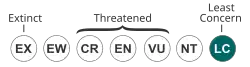
Scientists from the IUCN say this frog is not some danger of dying out.[1]
References
- 1 2 3 4 5 6 IUCN SSC Amphibian Specialist Group; Instituto Boitatá de Etnobiologia e Conservação da Fauna (2023). "Pará Thin-toed Frog: Leptodactylus paraensis". IUCN Red List of Threatened Species. 2023: e.T135811A184643685. doi:10.2305/IUCN.UK.2023-1.RLTS.T135811A184643685.en. Retrieved January 3, 2026.
- ↑ Frost, Darrel R. "Leptodactylus paraensis Heyer, 2005". Amphibian Species of the World, an Online Reference. Version 6.0. American Museum of Natural History, New York. Retrieved January 3, 2026.
- ↑ "Leptodactylus paraensis Heyer, 2005". AmphibiaWeb. University of California, Berkeley. Retrieved January 3, 2026.
- ↑ Heyer WR (2005). "Variation and taxonomic clarification of the large species of the Leptodactylus pentadactylus species group (Amphibia: Leptodactylidae) from Middle America, Northern South America, and Amazonia". Arquivos de Zoologia (Full text). 37: 269–348. doi:10.11606/issn.2176-7793.v37i3p269-348. Retrieved January 3, 2026.