Leptodactylus oreomantis
| Leptodactylus oreomantis | |
|---|---|
Scientific classification  | |
| Kingdom: | Animalia |
| Phylum: | Chordata |
| Class: | Amphibia |
| Order: | Anura |
| Family: | Leptodactylidae |
| Genus: | Leptodactylus |
| Species: | L. oreomantis |
| Binomial name | |
| Leptodactylus oreomantis Carvalho, Leite, and Pezzuti, 2013 | |
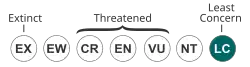
Leptodactylus oreomantis is a frog. It lives in Brazil.[2][3][1]
Home
Scientists saw the frog in Caatinga places and in rocky places.[4] Scientists saw the frog between 950 and 1575 meters above sea level.[1]
Scientists have seen this frog inside protected places, for example PARMU da Serra das Almas and PARNA da Chapada da Diamantina.[1]
Young
The male frog sits near water and calls to the female frogs. People have seen the tadpoles in small streams with sand in them and in puddles.[1]
Danger
Scientists from the IUCN say this frog is not in danger of dying out. In some places, human beings change the places where the frog lives to make farms and places for animals to eat grass.[1]
References
- 1 2 3 4 5 6 IUCN SSC Amphibian Specialist Group; Instituto Boitatá de Etnobiologia e Conservação da Fauna (2023). "Leptodactylus oreomantis". IUCN Red List of Threatened Species. 2023: e.T78518252A86254594. doi:10.2305/IUCN.UK.2023-1.RLTS.T78518252A86254594.en. Retrieved January 10, 2026.
- ↑ Frost, Darrel R. "Leptodactylus oreomantis Carvalho, Leite, and Pezzuti, 2013". Amphibian Species of the World, an Online Reference. Version 6.0. American Museum of Natural History, New York. Retrieved January 10, 2026.
- ↑ "Leptodactylus oreomantis Carvalho, Leite, & Pezzuti, 2013". AmphibiaWeb. University of California, Berkeley. Retrieved January 10, 2026.
- ↑ de Carvalho TR; Leite FSF; Pezzuti TL (2013). "A new species of Leptodactylus Fitzinger (Anura, Leptodactylidae, Leptodactylinae) from montane rock fields of the Chapada Diamantina, northeastern Brazil". Zootaxa (Abstract). 3701: 349–364. doi:10.11646/zootaxa.3701.3.5. PMID 26191589. Retrieved January 10, 2026.