Leptodactylus mystaceus
| Leptodactylus mystaceus | |
|---|---|
 | |
Scientific classification  | |
| Kingdom: | Animalia |
| Phylum: | Chordata |
| Class: | Amphibia |
| Order: | Anura |
| Family: | Leptodactylidae |
| Genus: | Leptodactylus |
| Species: | L. mystaceus |
| Binomial name | |
| Leptodactylus mystaceus (Spix, 1824) | |
| Synonyms[2] | |
| |
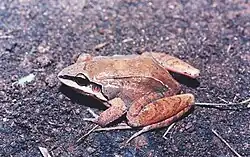
The mustache thin-toed frog, Amazonian white-lipped frog, rana dedilarga con bigote, or basin white-lipped frog (Leptodactylus mystaceus) is a frog. It lives in Venezuela, French Guiana, Guyana, Argentina, Peru, Suriname, Bolivia, Colombia, Ecuador, and Brazil. Scientists think it could also live in Peru.[2][3][1]
Home
This frog lives in many parts of the Amazon. It lives in forests that have never been cut down, forests that are growing back, grasslands inside forests, and flooded places. It lives on the ground near bodies of water that sometimes dry up. Scientists saw the frog between 0 and 1000 meters above sea level.[1]
Scientists saw the frog many protected places.[1]
Young
The male frog digs a hole in a muddy place. The female frog makes a nest out of foam in the hole and puts her eggs in it. The tadpoles swim and grow in water.[1]
Danger
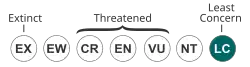
Scientists from the IUCN say this frog is not in danger of dying out. In some places, human beings change the places where the frog lives: fire, cutting down trees to get wood and make farms, and building towns, but the frog is good at living in places that people have changed.[1]
References
- 1 2 3 4 5 6 IUCN SSC Amphibian Specialist Group (2023). "Basin White-Lipped Frog: Leptodactylus mystaceus". IUCN Red List of Threatened Species. 2023: e.T179010704A85887259. doi:10.2305/IUCN.UK.2023-1.RLTS.T179010704A85887259.en. Retrieved October 30, 2025.
- 1 2 Frost, Darrel R. "Leptodactylus mystaceus (Spix, 1824)". Amphibian Species of the World, an Online Reference. Version 6.0. American Museum of Natural History, New York. Retrieved October 30, 2025.
- ↑ "Leptodactylus mystaceus (Spix, 1824)". AmphibiaWeb. University of California, Berkeley. Retrieved October 30, 2025.