Leptodactylus melanonotus
| Leptodactylus melanonotus | |
|---|---|
 | |
Scientific classification  | |
| Kingdom: | Animalia |
| Phylum: | Chordata |
| Class: | Amphibia |
| Order: | Anura |
| Family: | Leptodactylidae |
| Genus: | Leptodactylus |
| Species: | L. melanonotus |
| Binomial name | |
| Leptodactylus melanonotus (Cope, 1867) | |
| Synonyms[2] | |
| |
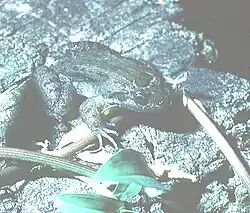
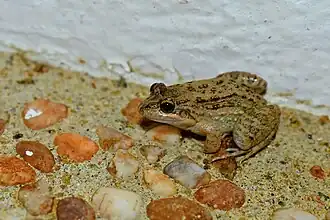
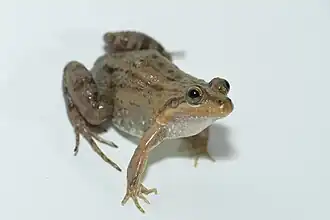
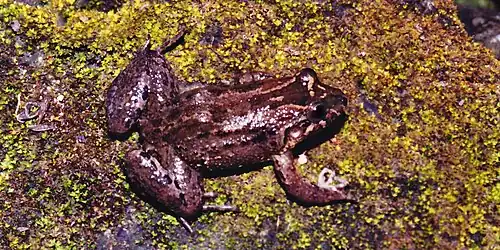
The Mexican river frog, rana dedilarga dorsinegra, black-backed frog, reddish-brown white-lipped frog, black jungle-frog, fringe-toed foamfrog, Sabinal frog, black-backed thin-toed frog(Leptodactylus melanonotus) is a frog. It lives in Mexico, Guatemala, Ecuador, Belize, Colombia, Costa Rica, El Salvador, Honduras, Nicaragua, and Panama.[2][3][1]
Home
This frog lives in forests but it can also live in mangrove tree swamps, grassy places, places where plants are growing back after being cut down, and flooded places where animals eat grass. Scientists saw the frog between 0 and 1550 meters above sea level.[1]
Scientists saw the frog in protected places: Meseta de Cacaxtla protected area, Chamela-Cuixmala Biosphere Reserve, Chamela-Cuixmala Biosphere Reserve, El Veladero National Park, Lagunas de Chacahua National Parks, Los Tuxtlas Biosphere Reserve, Pantanos de Centla Biosphere Reserve, Calakmul Biosphere Reserve, Laguna de Términos reserve, and Balaan Kaax reserve.[1]
Young
The frog digs a hole for its eggs. The female frog makes a nest out of bubbles to put her eggs in. If the hole becomes too dry, the female frog will dig to water to fill it with water again.[1]
Danger
Scientists from the IUCN say this frog is not in danger of dying out. Pollution from chemicals sprayed by airplanes might hurt this frog.[1]
References
- 1 2 3 4 5 6 IUCN SSC Amphibian Specialist Group (2020). "Sabinal Frog: Leptodactylus melanonotus". IUCN Red List of Threatened Species. 2020: e.T57144A53968833. doi:10.2305/IUCN.UK.2020-1.RLTS.T57144A53968833.en. Retrieved November 3, 2025.
- 1 2 Frost, Darrel R. "Leptodactylus melanonotus (Cope, 1867)". Amphibian Species of the World, an Online Reference. Version 6.0. American Museum of Natural History, New York. Retrieved November 3, 2025.
- ↑ Michelle S. Koo, ed. (August 10, 2025). "Leptodactylus melanonotus (Cope, 1867)". AmphibiaWeb. University of California, Berkeley. Retrieved November 3, 2025.