Leptodactylus lithonaetes
| Leptodactylus lithonaetes | |
|---|---|
 | |
Scientific classification  | |
| Kingdom: | Animalia |
| Phylum: | Chordata |
| Class: | Amphibia |
| Order: | Anura |
| Family: | Leptodactylidae |
| Genus: | Leptodactylus |
| Species: | L. lithonaetes |
| Binomial name | |
| Leptodactylus lithonaetes Heyer, 1995 | |
Leptodactylus lithonaetes is a frog. It lives in Colombia and Venezuela.[1][2][3]
Body
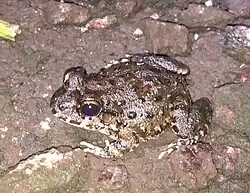
The adult frog is 28-36 mm long.. There is some webbed skin on the feet. There are warts and folded skin on the backs of most adults. Most adults have 6-8 spots on thier backs. The back and top of the head are brown in color.[2]
Home
This frog is awake at night. It lives in places with granite and sandstone rock near forest. Scientists have seen it between 89 and 1650 meters above sea level.[3]
Scientists have seen the frog in protected places: Orinoco-Casiquiare Biosphere Reserve, Cinaruco–Capanaparo National Park, Yapacana National Park, and Parque Nacional Natural El Tuparro.[3]
Young
This frog makes a nest out of bubbles for its eggs. The tadpoles live in places that have water but not always in water. For example, the tadpoles can live in rocks with a little water on them.[3]
Danger
Scientists from the IUCN and the Venezuelan Fauna Red List say this frog is not in danger of dying out. In some places, fires kill this frog.[3]
References
- ↑ Frost, Darrel R. "Leptodactylus lithonaetes Heyer, 1995". Amphibian Species of the World, an Online Reference. Version 6.0. American Museum of Natural History, New York. Retrieved December 24, 2025.
- 1 2 Ambika Sopory (January 12, 2001). Ambika Sopory (ed.). "Leptodactylus lithonaetes Heyer, 1995". AmphibiaWeb. University of California, Berkeley. Retrieved December 24, 2025.
- 1 2 3 4 5 IUCN SSC Amphibian Specialist Group (2020). "Leptodactylus lithonaetes". IUCN Red List of Threatened Species. 2020: e.T57141A85885948. doi:10.2305/IUCN.UK.2020-3.RLTS.T57141A85885948.en. Retrieved December 24, 2025.