Leptodactylus latrans
| Leptodactylus latrans | |
|---|---|
Scientific classification  | |
| Kingdom: | Animalia |
| Phylum: | Chordata |
| Class: | Amphibia |
| Order: | Anura |
| Family: | Leptodactylidae |
| Genus: | Leptodactylus |
| Species: | L. latrans |
| Binomial name | |
| Leptodactylus latrans (Steffen, 1815) | |
| Synonyms[2] | |
| |
The Argus frog, Criolla frog, butter frog, lesser foam frog, or South American spotted grass frog (Leptodactylus latrans) is a frog. It lives in Brazil, Bolivia, Uruguay, Paraguay, and Argentina.[2][3][1]
Body
The adult male frog is 90-120 mm long from nose to rear end and the adult female frog is 80-110 mm long. The skin of the frog's back is dark gray or red-brown in color with folded skin. There are dark spots with white around the edges. These spots look like eyes. There is one spot between the eyes. The male frog has strong front legs. This frog has only a little extra skin on its feet, so it can swim well but also jump and move on land.[3]
The adult frog can make its guts longer or shorter depending on the time of year and what the frog is doing. The male frogs have longer guts during the warm part of the year when there is a lot of food for the frogs to eat. The female frogs have longer guts during the cold part of the year when it is time to make eggs inside their bodies.[3]
Home
These frogs live in Atlantic Forest and Caatinga places. It can live in many different kinds of places. People see it in grassy places, forests, lakes, reservoirs, streams, swamps, people's gardens, and towns. It is good at living in places that human beings have changed. Scientists saw the frog between 0 and 900 meters above sea level.[1]
Scientists saw the frog in many protected places.[1]
People
Human beings sometimes eat this frog.[1]
Young
The male frog hides in water plants and calls to the female frogs. The female frog usually lays eggs in a pond that dries up for part of the year. She lays the eggs in a nest made of bubbles that the male frog makes. The bubble nest and the eggs inside it float on top of the water. Each nest is 12-25 cm long and has thousands to eggs in it. It has a hole in the middle that is 4-8 cm long. The female frog sometimes sits in the hole in the nest so she can scare away animals that want to eat the eggs, for example birds. Sometimes the adult frogs lay eggs on dry land before the rain. Then the rain turns the land into a pond. The tadpoles leave the nest and swim in the pond. Because they hatch before the pond is there, these tadpoles are bigger and stronger than the tadpoles of frog species that lay eggs after it rains.[3] The tadpoles swim together in schools.[1]
Danger
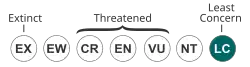
Scientists from the IUCN say this frog is not in danger of dying out. This frog is good at living in places that human beings have changed, for example gardens.[1]
First paper
- Lavilla EO; Langone JA; Caramaschi U; Heyer WR; de Sa RO (2010). "The identification of Rana ocellata Linnaeus, 1758. Nomenclatural impact on the species currently known as Leptodactylus ocellatus (Leptodactylildae) and Osteopilus brunneus (Gosse, 1851) (Hylidae)". Zootaxa. 2346: 1–16.
References
- 1 2 3 4 5 6 7 IUCN SSC Amphibian Specialist Group; Instituto Boitatá de Etnobiologia e Conservação da Fauna (2023). "Argus Frog: Leptodactylus latrans". IUCN Red List of Threatened Species. 2023: e.T194292713A85886595. doi:10.2305/IUCN.UK.2023-1.RLTS.T194292713A85886595.en. Retrieved November 11, 2025.
- 1 2 Frost, Darrel R. "Leptodactylus latrans (Steffen, 1815)". Amphibian Species of the World, an Online Reference. Version 6.0. American Museum of Natural History, New York. Retrieved November 11, 2025.
- 1 2 3 4 Joern Dietl; Susanne Fritz; Rebecca Kittel; Mirco Sole. Kellie Whittaker; Michalle S. Koo (eds.). "Leptodactylus latrans (Steffen, 1815)". AmphibiaWeb. University of California, Berkeley. Retrieved November 11, 2025.