Leptodactylus labrosus
| Leptodactylus labrosus | |
|---|---|
 | |
Scientific classification  | |
| Kingdom: | Animalia |
| Phylum: | Chordata |
| Class: | Amphibia |
| Order: | Anura |
| Family: | Leptodactylidae |
| Genus: | Leptodactylus |
| Species: | L. labrosus |
| Binomial name | |
| Leptodactylus labrosus Jiménez de la Espada, 1875 | |
| Synonyms[2] | |
| |
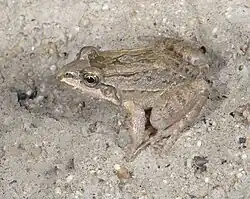
The Pimocha white-lipped frog, rana dedilarga de labio grueso, thick-lipped thin-toed frog, or rana terrestre labiosa (Leptodactylus rhodonotus) is a frog. It lives in Peru and Ecuador.[2][3][1]
Body
The adult male frog is 49.2–61.5 mm long from nose to rear end and the adult female frog is 39.9–69.0 mm long. This frog has big eyes that stick out from the head.[3]
Name
Scientists named the frog labrosus because that is the Latin word for "wide lip."[3]
Home
This frog lives in dry places with low, woody plants, and in forest with at least some trees whose leaves fall off. Sometimes it lives in evergreen forests, at the edges of forests, or on farms. This frog lives on the ground. People see it on the dead leaves on the ground and other places with water in the air. This frog is awake at night. Scientists saw the frog between 0 and 1300 meters above sea level.[3][1]
Scientists saw the frog in protected places: Machililla National Park, Manglares Churute National Park, and Mache Chindu National Park. They think it could also live in Parque Nacional Cerros de Amotape and El Angolo Game Preserve.[1]
Food
The adult frog eats animals with no bones that live on the ground, for example ants, earthworms, slugs, and caterpillars.[3]
Young
The female frog puts her eggs in holes near water. Later, water floods the holes[3][1] and the tadpoles swim out.
Danger
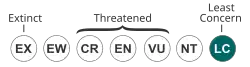
Scientists from the IUCN say this frog is not in danger of dying out.[1]
References
- 1 2 3 4 5 6 IUCN SSC Amphibian Specialist Group (2018). "Rana Terrestre Labiosa: Leptodactylus labrosus". IUCN Red List of Threatened Species. 2018: e.T57136A3056172. doi:10.2305/IUCN.UK.2018-1.RLTS.T57136A3056172.en. Retrieved November 6, 2025.
- 1 2 Frost, Darrel R. "Leptodactylus labrosus Jiménez de la Espada, 1875". Amphibian Species of the World, an Online Reference. Version 6.0. American Museum of Natural History, New York. Retrieved November 6, 2025.
- 1 2 3 4 5 6 Santiago R. Ron; Andrea Varela-Jaramillo; Morley Read; Gabriela Pazmiño-Armijos (September 8, 2013). Santiago R. Ron (ed.). "Leptodactylus labrosus Jiménez de la Espada, 1875". AmphibiaWeb (in Spanish). University of California, Berkeley. Retrieved November 6, 2025.