Leptodactylus insularum
| Leptodactylus insularum | |
|---|---|
 | |
Scientific classification  | |
| Kingdom: | Animalia |
| Phylum: | Chordata |
| Class: | Amphibia |
| Order: | Anura |
| Family: | Leptodactylidae |
| Genus: | Leptodactylus |
| Species: | L. insularum |
| Binomial name | |
| Leptodactylus insularum Barbour, 1906 | |
| Synonyms[2] | |
| |
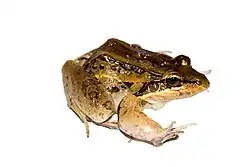
The San Miguel Island frog or Caribbean ditch frog (Leptodactylus insularum) is a frog. It lives in Colombia, Costa Rica, Peru, Panama, Venezuela, and Trinidad and Tobago. Scientists think it might also live in Bolivia.[2][3][1]
Body
The adult male frog is 66–104.6 mm long from nose to rear end and the adult female frog is 60.4–99.1 mm long.[1] The skin of the frog's back has folds and dark marks on it. There is a dark line from the nose to the eye. The backs of the legs have a dark pattern on them with light spots in strange shapes. The sides of the body are light brown with dark brown spots. The belly is very light brown in color. The adult frogs use the colors on their legs to confuse bigger animals that want to eat them.[3]
Home
These frogs live in forests near streams. Scientists saw the frog in many protected places.[1]
Food
The adult frogs eat water insects.[3]
Young
The male frog makes a nest out of bubbles for the eggs. The female frog can lay 2000 eggs at a time. The female frog protects the eggs and tadpoles. After the eggs hatch, the female frog leads the tadpoles to deep water.[1] If the water is about to dry up, the female frog will dig a small waterway so the tadpoles can swim to a new place. The tadpoles eat dead things that fall into the water.[3]
People
Sometimes people use this frog as bait when fishing.[1] Scientists found that this frog makes peptides in its skin, for example the peptide Ocellatin-3N, that can kill germs.[3]
Danger
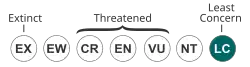
Scientists from the IUCN say this frog is not in danger of dying out. It is good at living in places that human people have changed. It can even live in the same places as the dangerous fungus Batrachochytrium dendrobatidis. B. dendrobatidis causes the disease chytridiomycosis, which kills frogs.[1]
First paper
- Barbour, T. (1906). "Vertebrata from the savanna of Panama—Reptilia; Amphibia". Bulletin of the Museum of Comparative Zoology. 46. Cambridge, Massachusetts: 224–230.
References
- 1 2 3 4 5 6 7 IUCN SSC Amphibian Specialist Group (2020). "San Miguel Island Frog: Leptodactylus insularum". IUCN Red List of Threatened Species. 2020: e.T85854383A85910948. doi:10.2305/IUCN.UK.2020-2.RLTS.T85854383A85910948.en. Retrieved November 20, 2025.
- 1 2 Frost, Darrel R. "Leptodactylus insularum Barbour, 1906". Amphibian Species of the World, an Online Reference. Version 6.0. American Museum of Natural History, New York. Retrieved November 20, 2025.
- 1 2 3 4 5 Marguerite Schlutius; Victoria Cao; Vanessa Martinez (June 21, 2021). Ann T. Chang (ed.). "Leptodactylus insularum Barbour, 1906". AmphibiaWeb. University of California, Berkeley. Retrieved November 20, 2025.