Leptodactylus discodactylus
| Leptodactylus discodactylus | |
|---|---|
 | |
Scientific classification  | |
| Kingdom: | Animalia |
| Phylum: | Chordata |
| Class: | Amphibia |
| Order: | Anura |
| Family: | Leptodactylidae |
| Genus: | Leptodactylus |
| Species: | L. discodactylus |
| Binomial name | |
| Leptodactylus discodactylus Boulenger, 1884 | |
| Synonyms[2] | |
| |
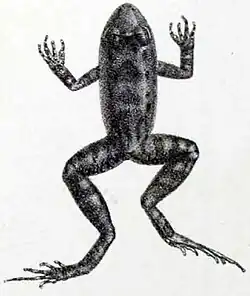
Vanzolini's Amazon frog, disc-shaped thin-toed frog, or rana dedilarga discada (Leptodactylus discodactylus) is a frog. It lives in Brazil, Bolivia, Ecuador, Colombia, and Peru.[2][3][1]
Body
The adult male frog is 28–35 mm long from nose to rear end and the adult female is 32–35 mm long. The sides of the frog's head are light brown in color. There is a triangle shape on the back. The skin of the frog's back is dark brown with some marks. The sides of the body are lighter in color, gray-brown or red-brown. The iris of the eye is bronze in color with brown lines.[3]
Name
Scientists named this frog using the Greek words "diskos" for disks and "daktylos" for fingers.[3]
Home
People see this frog in marshy places and in forests that flood at least some of the time. Scientists saw the frog between 100 and 1150 meters above sea level.[1]
There are many protected places where the frog lives: Parque Nacional Yasuní, Reserva Biólogica Limoncocha, Reserva de Producción Faunística Cuyabeno in Ecuador, Gueppi Reserved Zone in Peru, Reserva Extrativista do Alto Jurua, and Reserva Extrativista do Baixo Jurua.[1]
Danger
Scientists from the IUCN say this frog is not in danger of dying out. In some places, people change the places where the frog lives to get wood to build with, make farms, find oil, make places for animals to eat grass, or make places for people to live.[1]
References
- 1 2 3 4 5 IUCN SSC Amphibian Specialist Group (2023). "Vanzolini's Amazon Fro: Leptodactylus discodactylus". IUCN Red List of Threatened Species. 2023: e.T57373A3060320. doi:10.2305/IUCN.UK.2023-1.RLTS.T57373A3060320.en. Retrieved November 15, 2025.
- 1 2 Frost, Darrel R. "Leptodactylus discodactylus Boulenger, 1884". Amphibian Species of the World, an Online Reference. Version 6.0. American Museum of Natural History, New York. Retrieved November 15, 2025.
- 1 2 3 Diego A. Ortiz; Morley Read; Andrea Varela-Jaramillo; Santiago R. Ron (November 4, 2013). Santiago R. Ron (ed.). "Leptodactylus discodactylus Boulenger, 1884". AmphibiaWeb (in Spanish). University of California, Berkeley. Retrieved November 15, 2025.