Leptodactylus cunicularius
| Leptodactylus cunicularius | |
|---|---|
Scientific classification  | |
| Kingdom: | Animalia |
| Phylum: | Chordata |
| Class: | Amphibia |
| Order: | Anura |
| Family: | Leptodactylidae |
| Genus: | Leptodactylus |
| Species: | L. cunicularius |
| Binomial name | |
| Leptodactylus cunicularius Sazima and Bokermann, 1978 | |
Sazima's white-lipped frog, rabbit burrow frog, or rabbit foam frog (Leptodactylus cunicularius) is a frog. It lives in Goiás in Brazil.[2][3][1]
Home
This frog lives in cerrado places in the grassy places. It lives in sandy places with large rocks. Scientists have seen the frog between 745 and 1400 meters above sea level.[1]
Scientists have seen the frog in some protected places.[1]
Young
The male frog digs a hole in the sandy ground, sometimes under a rock. The female frog lays eggs in a nest made out of bubbles. When the rain falls, the foam nest disappears into the water and the tadpoles go to puddles and streams, where they swim and grow. Scientists think that some tadpoles stay in the foam nests until they become frogs.[1]
Danger
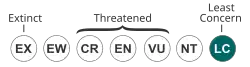
Scientists from the IUCN say this frog is not in danger of dying out. In some places, human beings change the places where the frog lives to make farms and places for animals to eat grass. The animals step on the sandy ground that the frogs need. Scientists look for this frog in places that humans have not changed, so they are not sure how good it is at living in places that humans have changed.[1]
References
- 1 2 3 4 5 6 Instituto Boitatá de Etnobiologia e Conservação da Fauna; IUCN SSC Amphibian Specialist Group (2023). "Sazima's White-lipped Frog: Leptodactylus cunicularius". IUCN Red List of Threatened Species. 2023: e.T57120A172224825. doi:10.2305/IUCN.UK.2023-1.RLTS.T57120A172224825.en. Retrieved December 14, 2025.
- ↑ Frost, Darrel R. "Leptodactylus cunicularius Sazima and Bokermann, 1978". Amphibian Species of the World, an Online Reference. Version 6.0. American Museum of Natural History, New York. Retrieved December 14, 2025.
- ↑ "Leptodactylus cunicularius Sazima & Bokermann, 1978". AmphibiaWeb. University of California, Berkeley. Retrieved December 14, 2025.