Leptodactylus colombiensis
| Leptodactylus colombiensis | |
|---|---|
Scientific classification  | |
| Kingdom: | Animalia |
| Phylum: | Chordata |
| Class: | Amphibia |
| Order: | Anura |
| Family: | Leptodactylidae |
| Genus: | Leptodactylus |
| Species: | L. colombiensis |
| Binomial name | |
| Leptodactylus colombiensis Heyer, 1994 | |
The rana picúa (Leptodactylus colombiensis) is a frog. It lives in Colombia and Venezuela.[2][3][1]
Home
This frog lives on the ground. It is awake at night. It lives in forests on hills and mountains. People have seen it in forests that were cut down and are growing back, forests that grow next to streams and rivers, and other forests. People have seen it on the dead leaves on the ground, in holes near water, and near the roots of water plants. Scientists have seen it between 300 and 2300 meters above sea level.[1]
Some of these frogs live in protected placess: Tinigua National Park, Páramo de Tamá National Park, Montes de Oca Forest Reserve, Guajira Forest Reserve, Las Jaguas Private Protection Area, and San Carlos Private Protection Area.[1]
People
Sometimes people who live near the frog catch it to use as bait when fishing.[1]
Food
This frog eats animals with no bones.[1]
Young
The male frog makes a nest out of bubbles and the female frog puts eggs in it.[1]
Danger
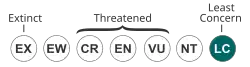
Scientists from the IUCN say this frog is not in danger of dying out. It can live in some places that people have changed, for example palm oil farms. In some places, the frog is in some danger from cow farms, towns, mines, and dams. The fungal disease chytridiomycosis can also hurt this frog.[1]
References
- 1 2 3 4 5 6 7 8 IUCN SSC Amphibian Specialist Group (2020). "Rana Picúa: Leptodactylus colombiensis". IUCN Red List of Threatened Species. 2020: e.T57119A85892577. doi:10.2305/IUCN.UK.2020-3.RLTS.T57119A85892577.en. Retrieved December 30, 2025.
- ↑ Frost, Darrel R. "Leptodactylus sabanensis Heyer, 1994". Amphibian Species of the World, an Online Reference. Version 6.0. American Museum of Natural History, New York. Retrieved December 30, 2025.
- ↑ Michelle S. Koo (August 1, 2021). "Rana Picúa: Leptodactylus colombiensis Heyer, 1994". AmphibiaWeb. University of California, Berkeley. Retrieved December 30, 2025.