Leptodactylus bolivianus
| Leptodactylus bolivianus | |
|---|---|
 | |
Scientific classification  | |
| Kingdom: | Animalia |
| Phylum: | Chordata |
| Class: | Amphibia |
| Order: | Anura |
| Family: | Leptodactylidae |
| Genus: | Leptodactylus |
| Species: | L. bolivianus |
| Binomial name | |
| Leptodactylus bolivianus Boulenger, 1898 | |
| Synonyms[1] | |
| |
The Bolivian white-lipped frog or Bolivian thin-toed frog (Leptodactylus bolivianus) is a frog. It lives in Brazil, Bolivia, Uruguay, Paraguay, and Argentina.[1][2][3]
Body
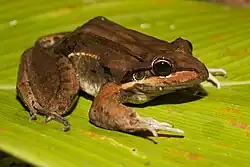
The adult male frog is 79.0-121.5 mm long from nose to rear end and the adult female is 61.2–107.7 mm long. The skin of the frog's back is light brown in color with darker brown spots and marks on the legs. There is a light colored mark above the mouth. The belly is also lighter in color.[2]
Home
This frog is usually awake at night. People see it in grassy places, forests, including forests that are growing back, swamps, places where animals eat grass, rice fields, and other places. The adults live in holes in the ground. Scientists saw the frog between 0 and 1400 meters above sea level.[3]
Scientists saw the frog in many protected places.[3]
Young
This frog lays eggs in a nest that it makes out of bubbles. It hides this nest in plants. The tadpoles swim in ponds where the water is not deep and is full of mud.[3]
Diet
This frog eats animals without bones, for example, beetles and ants. It can also eat smaller frogs.[3]
Danger
Scientists from the IUCN say this frog is not in danger of dying out. In some places, people catch this frog to eat.[3]
References
- 1 2 Frost, Darrel R. "Leptodactylus bolivianus Boulenger, 1898". Amphibian Species of the World, an Online Reference. Version 6.0. American Museum of Natural History, New York. Retrieved November 14, 2025.
- 1 2 Brian Freiermuth (November 2, 2009). Ann T. Chang (ed.). "Leptodactylus bolivianus Boulenger, 1898". AmphibiaWeb. University of California, Berkeley. Retrieved November 14, 2025.
- 1 2 3 4 5 6 IUCN SSC Amphibian Specialist Group (2023). "Bolivian White-lipped Frog: Leptodactylus bolivianus". IUCN Red List of Threatened Species. 2023: e.T85854608A3055205. doi:10.2305/IUCN.UK.2023-1.RLTS.T85854608A3055205.en. Retrieved November 14, 2025.