Leptodactylus apepyta
| Leptodactylus apepyta | |
|---|---|
 | |
Scientific classification  | |
| Kingdom: | Animalia |
| Phylum: | Chordata |
| Class: | Amphibia |
| Order: | Anura |
| Family: | Leptodactylidae |
| Genus: | Leptodactylus |
| Species: | L. apepyta |
| Binomial name | |
| Leptodactylus apepyta Schneider, Cardozo, Brusquetti, Kolenc, Borteiro, Haddad, Basso, and Baldo, 2019 | |
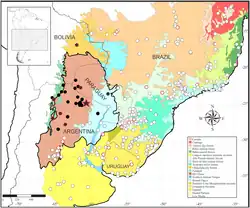 | |
Leptodactylus apepyta is a frog. It lives in Bolivia, Paraguay, and Argentina.[2][3][1]
Body
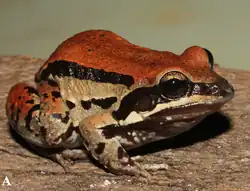
This frog is 46.80-66.21 mm long from nose to rear end. The skin of its body is reddish in color with black stripes. It has a round, dark ear.[4]
Home
Scientists saw the frog in chaco places and in some forests. Scientists saw the frog between 25 and 207 meters above sea level.[1]
Scientists have seen this frog inside protected places, for example Reserva Natural Cañada del Carmen.[1]
Young
The male frog sits on a log or on a plant up to 1 m above the ground and calls to the female frogs. They call after the sun goes down. The frog builds a nest out of bubbles for its eggs. The tadpoles swim in water.[1]
Danger
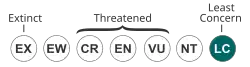
Scientists from the IUCN say this frog is not in danger of dying out. This frog is good at living in places that human beings have changed. In some places, human beings change the places where the frog lives by cutting down many trees and making places cows to eat grass. Forest fires can also hurt this frog.[1]
References
- 1 2 3 4 5 6 IUCN SSC Amphibian Specialist Group; Instituto Boitatá de Etnobiologia e Conservação da Fauna (2023). "Leptodactylus apepyta". IUCN Red List of Threatened Species. 2023: e.T174251934A174265483. doi:10.2305/IUCN.UK.2023-1.RLTS.T174251934A174265483.en. Retrieved January 11, 2026.
- ↑ Frost, Darrel R. "Leptodactylus apepyta Schneider, Cardozo, Brusquetti, Kolenc, Borteiro, Haddad, Basso, and Baldo, 2019". Amphibian Species of the World, an Online Reference. Version 6.0. American Museum of Natural History, New York. Retrieved January 11, 2026.
- ↑ "Leptodactylus apepyta Schneider, Cardozo, Brusquetti, Kolenc, Borteiro, Haddad, Basso, & Baldo, 2019". AmphibiaWeb. University of California, Berkeley. Retrieved January 11, 2026.
- ↑ Schneider RG; Cardozo DE; Brusquetti F; Kolenc F; Borteiro C; Haddad C; Basso NG; Baldo D. (2019). "A new frog of the Leptodactylus fuscus species group (Anura: Leptodactylidae), endemic from the South American Gran Chaco". PeerJ: 7:e7869 DOI 10.7717/peerj.7869. doi:10.7717/peerj.7869. PMID 31616603. Retrieved January 11, 2026.
{{cite journal}}: CS1 maint: unflagged free DOI (link)