Leptodactylus albilabris
| Leptodactylus albilabris | |
|---|---|
 | |
Scientific classification  | |
| Kingdom: | Animalia |
| Phylum: | Chordata |
| Class: | Amphibia |
| Order: | Anura |
| Family: | Leptodactylidae |
| Genus: | Leptodactylus |
| Species: | L. albilabris |
| Binomial name | |
| Leptodactylus albilabris (Günther, 1859) | |
| Synonyms[2] | |
| |
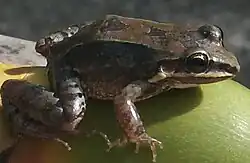
The Hispaniolan ditch frog, Antillean white-lipped frog, or Gunther's white-lipped frog (Leptodactylus albilabris) is a frog. It lives in the Virgin Islands, Puerto Rico, and the Dominican Republic. Scientists think it could also live in Peru.[2][3][1]
Home
This frog lives in the water and on land. People have seen it in marshes, streams, farmland, and other watery places in forests and places with few trees.[1]
Scientists saw the frog many protected places. It lives on all of Puerto Rico, so it lives in all Puerto Rico's protected parks. It also lives in St. John National Park in the U.S. Virgin Islands.[1]
Young
The male frogs call to the female frogs. The female frog makes a nest out of foam to put eggs in.[1]
Danger
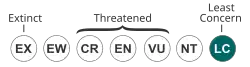
Scientists from the IUCN say this frog is not in danger of dying out, but it is in some danger. Climate change can change the whole Caribbean area, where the frog lives. It could change the rain and make the islands too hot, which could hurt the frog. If the sea level rises, the frogs could die from the salt water.[1]
Scientists found the dangerous fungus Batrachochytrium dendrobatidis on frogs in some places. This can cause the disease chytridiomycosis, which kills frogs. People brought the snake Xenochrophis vittatus to the frog's home. This snake is a danger to the frog too.[1]
References
- 1 2 3 4 5 6 7 IUCN SSC Amphibian Specialist Group (2021). "Ranita de Labio Blanco: Leptodactylus albilabris". IUCN Red List of Threatened Species. 2021: e.T57113A3055043. doi:10.2305/IUCN.UK.2021-1.RLTS.T57113A3055043.en. Retrieved October 27, 2025.
- 1 2 Frost, Darrel R. "Leptodactylus albilabris (Günther, 1859)". Amphibian Species of the World, an Online Reference. Version 6.0. American Museum of Natural History, New York. Retrieved October 27, 2025.
- ↑ "Leptodactylus albilabris (Günther, 1859)". AmphibiaWeb. University of California, Berkeley. Retrieved October 27, 2025.