Leonora, Western Australia
Leonora is a small town in the Goldfields-Esperance region of Western Australia. It is in the remote outback, about 833 kilometers (518 miles) northeast of the state capital, Perth. The town is known for its gold mining history and for its nearby ghost town, Gwalia.
| Leonora Western Australia | |||||||||
|---|---|---|---|---|---|---|---|---|---|
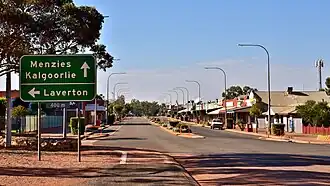 Tower Street, Leonora | |||||||||
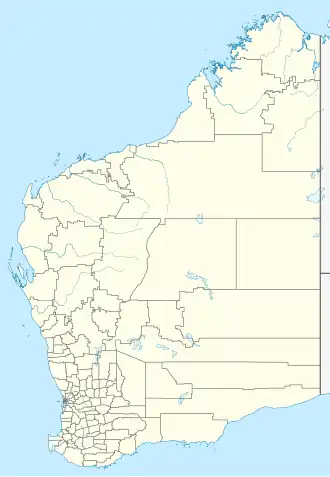  Leonora | |||||||||
| Coordinates | 28°53′04″S 121°19′51″E / 28.884498°S 121.330812°E | ||||||||
| Population | 567 (as of 2021) | ||||||||
| Elevation | 376 m (1,234 ft) | ||||||||
| Location |
| ||||||||
| |||||||||
History
The area was first visited by European explorer John Forrest in 1869.[1] He named a nearby hill Mount Leonora after his niece. The town got its name from this hill. In 1895, gold was discovered nearby. This started a gold rush, and the town of Leonora was officially created in 1897. A major gold mine, the Sons of Gwalia, was very important to the area. A famous person, Herbert Hoover, worked as the mine manager at the Sons of Gwalia mine. He later became the 31st President of the United States. His former house, Hoover House, is now a guest house. Leonora is very close to Gwalia, a famous ghost town. Gwalia was once a busy mining town, but when the Sons of Gwalia mine closed in 1963, most people left. Today, you can visit the old miners' cottages and the Gwalia Museum.
Economy
The main business in Leonora is mining. The area is a major producer of gold and also mines nickel. Modern mining operations are still very active next to the historic sites. There is also a small industry for raising cattle and sheep on large farms, called the pastoral industry. Leonora is an important town for people traveling and for the mining workers in the northern Goldfields.
Geography and Climate
Leonora is located in the dry, flat land of the outback. It is on the western edge of the Great Victoria Desert. The area has a hot desert climate. Summers are very hot, with mean (average) daily maximum temperature is about 37°C (98.6°F) in January. Winters are cool, with mean daily minimum temperature can drop to about 6°C (43°F) in July. Sometimes there can be frost in the morning. Rainfall is very low all year.
- ↑ Forrest, John (1875). Explorations in Australia. London: Sampson Low, Marston, Low, & Searle. Retrieved 2012-05-06.