Kargil War
| Kargil War | |||||||||
|---|---|---|---|---|---|---|---|---|---|
| Part of Indo-Pakistani wars and conflicts | |||||||||
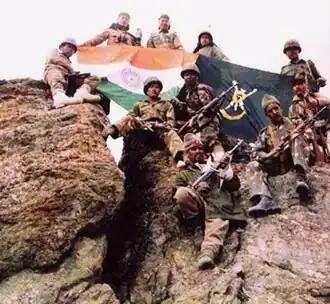 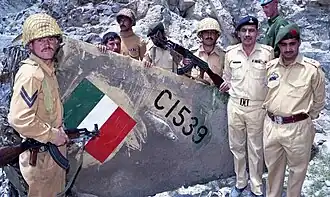 Top, bottom: Indian soldiers after capturing a hill from Pakistani forces during the Kargil War Pakistani soldiers with a shot-down Indian MiG-21 aircraft | |||||||||
| |||||||||
| Belligerents | |||||||||
 India |
 Pakistan  United Jihad Council[2]  Afghan mercenaries[3][4] | ||||||||
| Commanders and leaders | |||||||||
|
Atal Bihari Vajpayee V.P. Malik Yashwant Tipnis Nirmal Vij Krishnan Pal Mohinder Puri O. P. Nandrajog |
Nawaz Sharif Pervez Musharraf Aziz Khan Ashraf Rashid Tauqir Zia | ||||||||
| Strength | |||||||||
| 30,000 | 5,000 | ||||||||
| Casualties and losses | |||||||||
|
Indian figures:
Pakistani claims:
|
U.S. estimate figures:
Pakistani figures: Other Pakistani figures:
Indian claims: | ||||||||
The Kargil War also known as the Operation Vijay in India,[20] was a war fought between Indian armed forces and Pakistan Army in 1999. The Indian Air Force worked with Indian Army to remove the Pakistan Army and other soldiers from the occupied region in Kargil district.[21]
Beginning
The cause of the war was the infiltration of Pakistani soldiers and Pakistan backed militants into areas on the Indian side of the Line of Control (LoC) to occupy military posts vacated in the winter.[22] India responded by launching a major military and diplomatic offensive to drive out the Pakistani infiltrators.[23] Reportedly, the Pakistan infiltration in the Kargil sector was reported by the local shepherds.[24][25] The Indian Army launched a number of patrols to the area to estimate the extent of the infiltration.[25] Initially, Pakistan blamed the fighting entirely on independent Kashmiri militants, but documents left behind by casualties and later statements by Pakistan's Prime Minister and Chief of Army Staff revealed involvement of Pakistani paramilitary forces,[26][27][28] led by General Ashraf Rashid.[29] The Indian Army, later on supported by the Indian Air Force, recaptured majority of the positions on the Indian side of the LOC within two months of the conflict that were trespass by the infiltrators,[30][31] according to official count, an estimated 75%–80% of the intruded area and nearly all high ground was back under Indian control.[32] Fearing large-scale increase in seriousness in the military conflict, the international community, led by the United States, increased diplomatic pressure on Pakistan to withdraw forces from remaining Indian territory.[23][33] Faced with the possibility of international separation, the already fragile Pakistani economy was weakened further.[34][35] The morale of Pakistani forces after the withdrawal declined as many units of the Northern Light Infantry suffered heavy casualties.[36][37] The Pakistani government refused to accept the dead bodies of many officers,[38][39] which provoked anger and protests in the Northern Areas.[40][41] Pakistan initially did not admitted many of its casualties, but Nawaz Sharif later said that over 4,000 Pakistani troops were killed in the operation and that Pakistan had lost the conflict.[42][43] The Indian casualties during the conflict stood at 527 soldiers killed,[5][44][7] and 1,363 wounded.[45]
End
Pakistan lost the Kargil War. The conflict officially came to an end on July 26,[46][47] with India regaining its earlier hold on Kargil.[48]
The Kargil war is one of the most recent examples of high-altitude warfare in mountainous terrain.
Losses
There number of Pakistani people who died is different in different sources. Pervez Musharraf said that 357 soldiers were killed. In early stage, the US Department of State had said about 700 people died.
According to numbers given by Nawaz Sharif, there were over 4,000 dead. His PML (N) party in its "white paper" on the war wrote that more than 3,000 soldiers, officers and mujahideens were killed.[16]
Another big Pakistani political party, the Pakistan Peoples Party, also said that "thousands" of soldiers and irregulars died.[49]
Indian count says that 1,042 Pakistani soldiers killed.[50]
The official losses of India were given to be 527 dead and 1,363 wounded.[5][6][7]
References
- ↑
- Praagh, David Van (2003). The Greater Game: India's Race with Destiny and China. McGill-Queen's Press. p. 253. ISBN 9780773526396.
By then, India had won decisively in the mountains of Kashmir.
MacDonald, Myra (2017). Defeat is an Orphan: How Pakistan Lost the Great South Asian War. Oxford University Press. pp. 27, 53, 64, 66. ISBN 978-1-84904-858-3.p. 27: It was not so much that India won the Great South Asian War but that Pakistan lost it.p. 53: The story of the Kargil War—Pakistan's biggest defeat by India since 1971—is one that goes to the heart of why it lost the Great South Asian War.p. 64: Afterwards, Musharraf and his supporters would claim that Pakistan won the war militarily and lost it diplomatically. In reality, the military and diplomatic tides turned against Pakistan in tandem.p. 66: For all its bravado, Pakistan had failed to secure even one inch of land. Less than a year after declaring itself a nuclear-armed power, Pakistan had been humiliated diplomatically and militarily.
Lavoy, Peter René, ed. (2009). Asymmetric Warfare in South Asia: The Causes and Consequences of the Kargil Conflict. Cambridge University Press. p. 180. ISBN 978-0-521-76721-7.The false optimism of the architects of the Kargil intrusion, colored by the illusion of a cheap victory, was not only the main driver of the operation, and hence the crisis, it also was the cause of Pakistan's most damaging military defeat since the loss of East Pakistan in December 1971.
Dettman, Paul R. (2001). India Changes Course: Golden Jubilee to Millennium. Greenwood. pp. 130, 131, 140, 177. ISBN 978-0-275-97308-7.p. 130: the BJP could go to the people as the party that had undergirded India's victory over Pakistan in the Kargil 'war'.p. 131: Another of India's institutions that had benefited from India's victory in the Kargil war was its military establishment.p. 140: He went on to take credit for the conduct of a 'war' effort that had led to a diplomatic as well as a military victory.p. 177: For India, Vajpayee had led the military and diplomatic effort that had won the Kargil 'war'. For the world, he had done so while keeping India's armed forces on their own side of the LOC in Kashmir and he had prevented the outbreak of a multi-front general war with Pakistan.
Perkovich, George (2002). India's Nuclear Bomb: The Impact on Global Proliferation. University of California Press. p. 479. ISBN 978-0-520-23210-5.The Kargil war ended as had previous wars, with an Indian victory.
- Praagh, David Van (2003). The Greater Game: India's Race with Destiny and China. McGill-Queen's Press. p. 253. ISBN 9780773526396.
- ↑ Kumar, Sumita. "Pakistan's Jehadi Apparatus: Goals and Methods." Strategic Analysis, vol. 24, no. 12, 2001, https://ciaotest.cc.columbia.edu/olj/sa/sa_mar01kus01.html.
- ↑ It is estimated that around 2,000 "Mujahideen" might have been involved as Musharraf stated on 6 July 1999, to Pakistan's The News; online article, Asia Times quoting the General's estimate. An Indian Major General (retd) too puts the "Number of guerrillas at 2,000" Archived 6 January 2006 at the Wayback Machine, apart from the NLI Infantry Regiment.
- ↑ Malik, V.P. (Summer 2009), "The Kargil War: Some Reflections" (PDF), CLAWS Journal, archived from the original (PDF) on 9 August 2019, retrieved 24 January 2018
- 1 2 3 Chakraborty, A. K. (21 July 2000). "Kargil War Brings into Sharp Focus India's Commitment to Peace" (PDF). Press Information Bureau, Government of India. Archived (PDF) from the original on 26 July 2022. Retrieved 26 July 2022. Cite error: Invalid
<ref>tag; name "pib" defined multiple times with different content. - 1 2 Fernandes, George (28 November 2002). "Soldiers Killed in Kargil War". Parliamentary Questions, Lok Sabha. Parliament of India. Starred Question No 160. Archived from the original on 2 December 2008. Retrieved 20 May 2009.
- 1 2 3 "Complete Roll of Honour of Indian Army's Killed in Action during Op Vijay". Indian Army. Archived from the original on 22 December 2007. Retrieved 20 May 2009. Cite error: Invalid
<ref>tag; name "rollofhonor" defined multiple times with different content. - ↑ Fernandes, George (8 December 1999). "Soldiers Killed During Indo Pak Wars". Parliamentary Questions, Lok Sabha. Parliament of India. Unstarred Question No 793. Archived from the original on 16 February 2008. Retrieved 20 May 2009.
- ↑ "Musharraf claims Kargil was a big success militarily for Pakistan". Greater Kashmir. 1 February 2013. Archived from the original on 29 May 2013. Retrieved 6 April 2013.
- ↑ "Kargil probe body had sought Musharraf's court martial". The News. AFP. 13 January 2013. Archived from the original on 27 February 2021. Retrieved 22 March 2021.
- ↑ "Pak quietly names 453 men killed in Kargil war". Rediff News. 18 November 2010. Archived from the original on 27 June 2018. Retrieved 6 April 2013.
- ↑ "Pakistan Army admits to Kargil martyrs". NDTV. Archived from the original on 21 November 2010. Retrieved 19 November 2010.
- ↑ "PAKISTAN ARMY". pakistanarmy.gov.pk. Archived from the original on 28 April 2024. Retrieved 1 April 2025.
- 1 2 "Musharraf now has Pak's Kargil toll: 357". indianexpress.com. 7 October 2006. Retrieved 2 February 2013.
- ↑ "Tribune Report on Pakistani POWs". Archived from the original on 18 January 2012. Retrieved 20 May 2009.
- 1 2 Ill-conceived planning by Musharraf led to second major military defeat in Kargil: PML-N Archived 22 October 2006 at the Wayback Machine 6 August 2006, PakTribune
- ↑ Malik 2006, p. 342.
- ↑ Pubby, Manu (19 November 2010). "Kargil: Pak suffered most casualties at Batalik". The Indian Express. Archived from the original on 27 June 2018. Retrieved 27 June 2018.
Indian records say a total of 249 bodies of Pakistani soldiers were recovered during the battle but estimates of total enemy casualties is put around 1000–1200.
- ↑ Kanwal, Gurmeet (2009). "Pakistan's Strategic Blunder at Kargil" (PDF). CLAWS Journal: 72. Archived from the original (PDF) on 18 August 2019. Retrieved 27 June 2018.
The army recovered 249 dead bodies of Pakistani regular soldiers from the area of operations in Kargil; 244 dead bodies were buried as per military norms with religious rites; five bodies were accepted by Pakistan and taken back
- ↑ It is also sometimes referred to as Operation Vijay Kargil so as to distinguish it from Operation Vijay, the 1961 operation by the military of India that led to the capture of Goa, Daman and Diu and Anjidiv Islands.
- ↑ "Op Safed Sagar: Understanding Air Operations in Kargil". Indian Air Force. Archived from the original on 6 August 2021.
- ↑ Cite error: The named reference
1999 Kargil Conflictwas used but no text was provided for refs named (see the help page). - 1 2 Wolpert, Stanley (14 Aug 2010). "Recent Attempts to Resolve the Conflict". India and Pakistan: Continued Conflict or Cooperation?. University of California Press. p. 73. ISBN 978-0-520-27140-1.
- ↑ Bahl, Y (2000). "The Shepherds Story". Kargil Blunder: Pakistan's Plight, India's Victory. Manas Publications. p. 172. ISBN 978-81-7049-120-0.
It has been reported by a section of the press that it was some local shepherds who informed the army about the presence of Pakistani intruders on our side of LOC
- 1 2 Shastri, Amita; Wilson, A. Jeyaratnam (2013). The Post-Colonial States of South Asia: Political and Constitutional Problems. Routledge. ISBN 978-1-136-11874-6. Retrieved 15 July 2016.
- ↑ Clancy, Tom; Zinni, Anthony C. (2004). Battle Ready. Grosset & Dunlap. ISBN 978-0-399-15176-7.
- ↑ "Pak commander blows the lid on Islamabad's Kargil plot". 12 June 2009. Retrieved 13 June 2009.
- ↑ "Sharif admits he let down Vajpayee on Kargil conflict". The Hindu. Chennai, India. 10 September 2007. Retrieved 6 October 2007.
- ↑ Nawaz, Shuja, Crossed Swords: Pakistan, Its Army, and the Wars Within, p. 420 (2007)
- ↑ Ali, Tariq. "Bitter Chill of Winter". London Review of Books. Retrieved 2009-05-20.
- ↑ Nanda, Ravi (1999). Kargil: A Wake Up Call. Vedams Books. ISBN 978-81-7095-074-5. Online summary of the Book Archived 2007-09-28 at the Wayback Machine
- ↑ Kargil: where defence met diplomacy - India's then Chief of Army Staff VP Malik, expressing his views on Operation Vijay. Hosted on Daily Times; The Fate of Kashmir By Vikas Kapur and Vipin Narang Archived 2012-01-18 at the Wayback Machine Stanford Journal of International Relations; Book review of "The Indian Army: A Brief History by Maj Gen Ian Cardozo" - Hosted on IPCS
- ↑ R. Dettman, Paul (2001). "Kargil War Operations". India Changes Course: Golden Jubilee to Millennium. Greenwood Publishing Group. pp. 119–120. ISBN 978-0-275-97308-7.
- ↑ Samina Ahmed. "Diplomatic Fiasco: Pakistan's Failure on the Diplomatic Front Nullifies its Gains on the Battlefield" Archived 2016-03-04 at the Wayback Machine (Belfer Center for International Affairs, Kennedy School of Government)
- ↑ Daryl Lindsey and Alicia Montgomery. "Coup d'itat: Pakistan gets a new sheriff". salon.com. Archived from the original on 20 December 2009. Retrieved 19 June 2015.
- ↑ "War in Kargil - The CCC's summary on the war" (PDF). Archived from the original (PDF) on 2004-02-21. Retrieved 2009-05-20.
- ↑ Samina Ahmed. "A Friend for all Seasons." Archived 2016-03-04 at the Wayback Machine (Belfer Center for International Affairs, Kennedy School of Government)
- ↑ "Rediff On The NeT: Pakistan refuses to take even officers' bodies". rediff.com. Retrieved 19 June 2015.
- ↑ "press release issued in New Delhi regarding bodies of two Pakistan Army Officers"
- ↑ Second-Class Citizens by M. Ilyas Khan, The Herald (Pakistan), July 2000. Online scanned version of the article Archived 2011-07-21 at the Wayback Machine(PDF)
- ↑ Musharraf and the truth about Kargil Archived 2011-05-03 at the Wayback Machine - The Hindu 25 September 2006
- ↑ "Over 4000 soldier's killed in Kargil: Sharif". The Hindu. Retrieved 2009-05-20.
- ↑ Kapur, S. Paul (2007). Dangerous Deterrent: Nuclear Weapons Proliferation and Conflict in South Asia (23rd ed.). Stanford University Press. p. 227. ISBN 978-0-8047-5549-8.
- ↑ "Breakdown of casualties into Officers, JCOs, and Other Ranks". Parliament of India Website. Retrieved 2009-05-20.
- ↑ "Official statement giving breakdown of wounded personnel". Parliament of India Website. Archived from the original on February 16, 2008. Retrieved 2009-05-20.
- ↑ SarDesai, D. R (2007). India: The Definitive History. Westview Press. p. 450. ISBN 978-0-8133-4352-5. Retrieved 15 July 2016.
- ↑ Singh, Danvir (Col) (2014). Kashmir's Death Trap: Tales of Perfidy and Valour. Lancer Publishers LLC. ISBN 978-1-940988-13-9. Retrieved 15 July 2016.
- ↑ Lyon, Peter (2008). Conflict Between India and Pakistan: An Encyclopedia (illustrated ed.). ABC-CLIO. p. 81. ISBN 978-1-57607-712-2. Retrieved 15 July 2016.
- ↑ "Indo-Pak summit 2001". Pakistan Peoples Party. 12 October 2007. Archived from the original on 12 October 2007. Retrieved 27 May 2009.
- ↑ "Hindustan Times – Archive News". Hindustan Times. Archived from the original on 30 September 2007.