Kandake (royal title)
| Kandake of Sudan | |
|---|---|
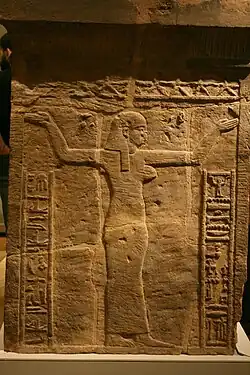 Relief depicting Kandake Amanitore | |
| Details | |
| Style | Nubian monarchy |
| First monarch |
|
| Last monarch |
|
| Formation | c. middle 2nd century BCE[1] |
| Abolition | c. AD 350[3] |
| Residence | Ancient Sudan |
| Appointer | Hereditary |
Kandake, kadake or kentake (Meroitic: 𐦲𐦷𐦲𐦡 kdke),[4] often Latinised as Candace (Ancient Greek: Κανδάκη, Kandakē),[4] was the Meroitic term for the sister of the king of Kush who, due to the matrilineal succession, would bear the next heir, making her a queen mother. She had her own court, probably acted as a landholder[5] and held a prominent secular role as regent.[6] Contemporary Greek and Roman sources treated it, incorrectly, as a name. The name Candace is derived from the way the word is used in the New Testament (Acts 8:27).[7][8][9]
A kandake who ruled in her own right bore in addition the title qore, the same title carried by male rulers.[10]
Biblical usage

In the New Testament, a treasury official of "Candace, queen of the Aethiopians", returning from a trip to Jerusalem, met with Philip the Evangelist:
Now an angel of the Lord said to Philip, "Rise and go toward the south to the road that goes down from Jerusalem to Gaza." This is a desert place. And he rose and went. And there was an Aethiopian eunuch, a court official of Candace, queen of the Aethiopians, who was in charge of all her treasure. He had come to Jerusalem to worship[11]
He discussed with Philip the meaning of a perplexing passage from the Book of Isaiah.[12] Philip explained the scripture to him and he was promptly baptised in some nearby water. The eunuch 'went on his way, rejoicing',[13] and presumably therefore reported back on his conversion to the Kandake.
List of ruling kandakes
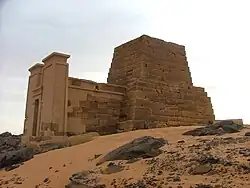
At least eleven kandakes also ruled in their own right as monarchs (i.e. queens regnant) of Kush:
- Nahirqo (middle 2nd century BC)[1]
- An unknown queen regnant (end of the 2nd–first half of the 1st century BC)[1]
- Amanirenas (end of the 1st century BC–beginning of the 1st century AD)[1]
- Amanishakheto (early 1st century AD)[1]
- Shanakdakhete (first half of the 1st century AD)[1]
- Nawidemak (first half of the 1st century AD?)[1]
- Amanitore (middle 1st century AD)[1]
- Amanikhatashan (middle 2nd century AD?)[1]
- Amanikhalika (second half of the 2nd century AD)[14]
- patrapeamani (early 4th century)[2]
- Amanipilade (mid-4th century)[2]
Based on the reading of a single inscription, some lists give two later kandakes named Maloqorebar (266–283 AD) and Lahideamani (306-314 AD).[15] A recently discovered inscription corrects this earlier reading, however, showing that neither was a woman.[16]
Related pages
- Kandake of the Sudanese Revolution
References
- 1 2 3 4 5 6 7 8 9 10 Kuckertz, Josefine (2021). "Meroe and Egypt". UCLA Encyclopedia of Egyptology: 5, 11–13.
- 1 2 3 Török, László (2015). The Kingdom of Kush: Handbook of the Napatan-Meroitic Civilization. BRILL. p. 206. ISBN 978-90-04-29401-1.
- ↑ Kuckertz, Josefine (2021). "Meroe and Egypt". UCLA Encyclopedia of Egyptology: 22.
- 1 2 Kirsty Rowan, "Revising the Sound Value of Meroitic D: A Phonological Approach," Archived 2023-05-22 at the Wayback Machine Beitrage zur Sudanforschung 10 (2009).
- ↑ Lohwasser, Angelika (1999). "Die Frau im antiken Sudan" (PDF). p. 131.
- ↑ Khan, Dan'el (2012). "The Queen Mother in the Kingdom of Kush: Status, Power and Cultic Role". Teshura le-Zafrira: Studies in the Bible, the History of Israel, and the Ancient Near East Presented to Zafrira Ben-Barak of the University of Haifa. pp. 67–68.
- ↑ Lobban, Richard A. Jr. (2003). Historical Dictionary of Ancient and Medieval Nubia. Lanham, MD: Scarecrow Press. ISBN 978-0-8108-6578-5.
- ↑ Miriam Ma'at-ka-re Monges (2005). "Kush". In Molefi Kete Asante, Ama Mazama (ed.). Encyclopedia of Black Studies. Sage. p. 302. ISBN 978-0-7619-2762-4.
- ↑ Fage, John (23 October 2013). A History of Africa. Routledge. p. 115. ISBN 978-1317797272.
- ↑ László Török (1997), The Kingdom of Kush: Handbook of the Napatan–Meroitic Civilization, Brill, pp. 213–214.
- ↑ "Acts 8:27 Study Bible: And he arose and went; and look, there was a man from Ethiopia, a eunuch of great authority under Candace, queen of the Ethiopians, who was over all her treasure, who had come to Jerusalem to worship". biblehub.com. Retrieved 2025-05-29.
- ↑ Isaiah 53:7–8
- ↑ Acts 8:39
- ↑ Eder, Walter; Renger, Johannes; Henkelman, Wouter; Chenault, Robert (2007). Chronologies of the Ancient World: Names, Dates and Dynasties. Brill. p. 55. ISBN 978-90-04-15320-2.
- ↑ Mark, Joshua. "The Candaces of Meroe". World History Encyclopedia. Retrieved 2 June 2019.
- ↑ Claude Rilly (2017), "New Light on the Royal Lineage in the Last Decades of the Meroitic Kingdom: The inscription of the Temple of Amun at Meroe Found in 2012 by the Sudanese–Canadian Mission", Sudan and Nubia 21: 144–147 (appendix to "The Amun Temple at Meroe Revisited" by Krzysztof Grzymski).
Sources
- Harris, G.L.A. (2014). Living Legends and Full Agency: Implications of Repealing the Combat Exclusion Policy. CRC Press. ISBN 978-1-4665-1378-5.