Kalachuri era
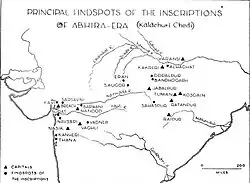
The Kalachuri era also called the Chedi era or the Haihaya era[1][2][3] was a Hindu system of year numbering started by King Isvarasena,[4] in which the year numbering started at some time from 248-250 CE.[4][5]
Origin
According to Historian V.V. Mirashi Abhira Isvarasena founded the Abhira kingdom at the middle of the 3rd Century A.D and to commemorate this occasion he started Abhira era in 248-249 A.D. which later on came to be known as the Kalachuri-Chedi era.[6]
The German scholar F. Kielhorn suggested that the system began in September 248, the year that began with the month of Asvina.[7][8] It was first used in Gujarat and Maharashtra (particularly Northern Maharashtra[9]), from where it spread to Madhya Pradesh and Uttar Pradesh where it was used until the 13th century CE.[5]
According to C.V. Vaidya this era is said to have been found in use ineven Western India via., Gujarat and Konkan and it is therefore probable that the Kalachuris enjoyed an intensive rule in centuries preceding even the Chalukayas of the Deccan. In fact it may be asserted that they succeeded to a great portion of the Andhra empire of the Satavahanas. They were certainly in possession of the almost impregnable stronghold of Kalanjara for a long time and had extended their sway up to Jamuna whence the name of Cedi was given to them.[10]
Usage by Dynasties
Inscriptions dated in the Kalachuri-Chedi era have been issued by several dynasties, including:[11][12][13][14]
- The Maharajas of Valkha
- Uchchhakalpa dynasty
- The Traikutakas
- The Kalachuris
- The early Rashtrakutas of Vidarbha
- The Maitrakas of Valabhi
- The early Gurjaras
- The early Chalukyas of Gujarat
- The Sendrakas
- The dynasty of Hariscandras
References
- ↑ The New Encyclopaedia Britannica: Macropaedia (19 v.). Encyclopaedia Britannica. 1983. pp. v. 4 p. 574. ISBN 978-0-85229-400-0.
the Kalacuri era ( AD 248 ), founded by the Abhūrī king Iśvarasena and first used in Gujarat and Mahārāsh-tra and later (until the 13th century) in Madhya Pradesh and as far north as Uttar Pradesh.
- ↑ Archaeology, India Dept of (1959). Indian Archaeology: A Review. Department of Archaeology. p. 42.
- ↑ Luard, Charles Eckford (1908). A Bibliography of the Literature Dealing with the Central India Agency: To which is Added a Series of Chronological Tables. Eyre and Spottiswoode. p. 51.
- 1 2 Chattopadhyaya, Sudhakar (1974). Some Early dynasties of South India. Motilal Banarsidass. p. 100. ISBN 81-208-2941-7.
- 1 2 The New Encyclopædia Britannica. Encyclopædia Britannica. 1974. pp. v. 4 p. 574. ISBN 0-85229-290-2.
- ↑ India, Numismatic Society of (1991). The Journal of the Numismatic Society of India. Numismatic Society of India, P.O. Hindu University. p. 93.
- ↑ Morgan, E. Delmar (1893). Transactions of the Ninth Oriental Congress of Orientalists, Vol. I. p. 429.
- ↑ Indian Antiquary, Volume XIX. Bombay: Kegan Paul, Trench, Trubner & Co. 1890. p. 228.
- ↑ Agnihotri, V.K. (2010). Indian History, Twenty-Sixth Edition. New Delhi: Allied Publishers. pp. xviii. ISBN 978-81-8424-568-4.
- ↑ Singh Yadav, J[ai] N[arain (1992). Yadavas Through The Ages, Vol. II.
- ↑ Dutta, Saroj (1995). Land System in Northern India, C. AD 400-c. AD 700. Munshiram Manoharlal Publishers. p. 5. ISBN 978-81-215-0657-1.
- ↑ Journal of the Epigraphical Society of India. The Society. 1987. p. 43.
- ↑ Journal of Indian History. 1935. p. 22.
- ↑ Mirashi, Vasudev Vishnu (1996-01-01). Bhavabhūti; [his Date, Life, and Works: His Date, Life and Works. Motilal Banarsidass Publishing House. pp. 14–15. ISBN 978-81-208-1180-5.