John White (surgeon)
John White | |
|---|---|
 | |
| Born | c.1756 Drumaran, Belcoo, County Fermanagh |
| Died | 20 February 1832 |
| Citizenship | Kingdom of Ireland and, later, British |
| Scientific career | |
| Fields | surgeon, zoologist, botanist |
| Institutions | Royal Navy |
John White (c.1756 – 20 February 1832) was an Irish surgeon and plant collector.
Biography
White was born around 1756 in Drumaran, near Belcoo, County Fermanagh, in northern Ireland.[1][2][3][4] Some books wrongly say he was born in Sussex, England.[5][6] On 18 June 1778, he became a qualified surgeon's mate after passing an exam in London. He joined the Royal Navy on 26 June 1778 as a surgeon's mate on the ship HMS Wasp. In 1780, he was promoted to surgeon and worked on HMS Irresistible until 1786. Then, Sir Andrew Hamond recommended him to be the main naval surgeon for the First Fleet voyage to Australia.[7]
In March 1787, White joined the First Fleet at Plymouth as the surgeon on the convict ship Charlotte.[6] When they arrived in Australia, White hired a convict named Thomas Barrett to make a silver medal to mark the event.[8] This medal, called the "Charlotte Medal," is now in Australia's National Maritime Museum.[8]
In 1788, White became the Surgeon-General of New South Wales and set up a hospital for the new colony, though he had few medical supplies. He became interested in Australian plants and animals and studied how plants could be used as medicine. He noticed the smell of eucalyptus and made eucalyptus oil in 1788.
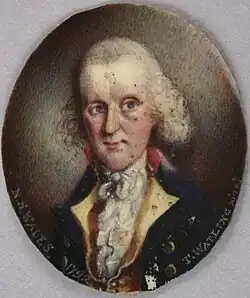
White wrote a book called A Journal of a Voyage to New South Wales in 1790.[9] It described many Australian plants and animals for the first time.[10] The book had 65 pictures of birds, animals, and plants, many based on paintings by Sarah Stone.[11][12] The book was soon translated into German and French.[6] It is thought that Thomas William Parr helped White by making sketches for the pictures.[13] White was the first to describe a frog called Litoria caerulea, also known as "White's tree frog." In 1792, a convict artist named Thomas Watling helped White copy drawings of plants, insects, and animals. A small portrait of John White painted by Watling in 1792 is in the National Museum of Australia.[14]
White did not like Australia. He wrote in his journal that it was a "country and place so forbidding and so hateful." He asked for leave in 1792 and got it in 1794. He sailed back to England on 17 December 1794 and later went to Ireland. In 1796, he quit his job instead of going back to Australia. That year, he was made a Fellow of the Linnean Society of London. On 10 March 1797, the University of St Andrews gave him a Doctor of Medicine degree. White worked as a surgeon on the ship HMS Royal William, first at Sheerness from 1799 and then at Chatham Dockyard from 1803. He retired with a half pension in 1820 and died in Worthing, England, in 1832.[15]
Legacy
Sydney's White Bay is named in his honour.[16]
A species of Australian lizard, Egernia whitii is named after him.[17]
References
- ↑ Nelson E.C. (1998). "John White A. M., M. D., F. L. S. (c.1756–1832), Surgeon-General of New South Wales: a new biography of the messenger of the echidna and the waratah". Archives of Natural History. 25 (2): 149–212. doi:10.3366/anh.1998.25.2.149.
- ↑ Nelson, E. C. (1986), "The first Ulsterman in Botany Bay, Surgeon-General John White', The Linen Hall review 3 (2): 8–9
- ↑ Nelson E.C. (1987). "From the banks of Erne to Botany Bay: John White (c.1756–1832), Surgeon-General of New South Wales". Familia. 2 (3): 73–82.
- ↑ Nelson E.C. (1988). "'John White (c.1756–1832), surgeon-general of New South Wales: biographical notes on his Irish origins". Irish Historical Studies. 25 (100): 405–412. doi:10.1017/S0021121400025074. PMID 11617226. S2CID 34987163.
- ↑ Percival Serle (1949). "White, John". Dictionary of Australian Biography. Angus & Robertson. Retrieved 16 September 2007.
- 1 2 3 Rienits, Rex (1967). "White, John (1756–1832)". Australian Dictionary of Biography. Vol. 2. Melbourne University Press. ISSN 1833-7538. Retrieved 7 March 2015 – via National Centre of Biography, Australian National University.
- ↑ Correspondence, Sir A.S. Hamond to Under Secretary Charles Nepean,16 October 1786. Cited in Britton (ed.), p.24
- 1 2 Barlass, Tim (16 November 2013). "Damaged First Fleet copper medal to fetch pretty penny". Sun Herald. p. 20.
- ↑ Nelson, E. Charles (1998). "John White's Journal of a voyage to new South Wales (London 1790) bibliographic notes". Archives of Natural History. 25: 109–130. doi:10.3366/anh.1998.25.1.109.
- ↑ Bauer, Aaron Matthew (1999). "Notes on John White's Journal of a Voyage to New South Wales (1790), a Classic of Australian Herpetology" (PDF). International Society for the History and Bibliography of Herpetology Newsletter and Bulletin. 1 (1): 16–19. Archived from the original (PDF) on 14 July 2018. Retrieved 5 May 2019.
- ↑ Piggot L.J. (2000). "John White's Journal of a voyage to new South Wales (1790) comments on the natural history and the artistic origins of the plates". Archives of Natural History. 27 (2): 157–174. doi:10.3366/anh.2000.27.2.157.
- ↑ Dickson, Nicola Jan (2010). Wonderlust: the influence of natural history illustration and ornamentation on perceptions of the exotic in Australia (PDF) (Doctor of Philosophy). Australian National University. Retrieved 12 November 2015.
- ↑ "Parr, Thomas William". Trove. Design and Art Australia Online. Retrieved 19 Oct 2019.
- ↑ "Thomas Watling portrait of John White | National Museum of Australia". www.nma.gov.au. Retrieved 2025-08-17.
- ↑ Nelson E.C. (1998). "John White A. M., M. D., F. L. S. (c.1756–1832), Surgeon-General of New South Wales: a new biography of the messenger of the echidna and the waratah". Archives of Natural History. 25 (2): 149–212. doi:10.3366/anh.1998.25.2.149.
- ↑ "White Bay". Geographical Names Register (GNR) of NSW. Geographical Names Board of New South Wales.
- ↑ Beolens, Bo; Watkins, Michael; Grayson, Michael (2011). The Eponym Dictionary of Reptiles. Baltimore: Johns Hopkins University Press. xiii + 296 pp. ISBN 978-1-4214-0135-5. ("White, J.", p. 284).